
x
N
G

Ron Zacapa XO: The Sip India Never Had
The Rum Conversation We’re Finally Ready For
If you think we are a whisky drinking country, perhaps yes — one of the highest consumers in the world, population notwithstanding. But rum has always been a force to reckon with when it comes to spirited interventions. It just never got the conversation it deserved.
Oddly enough, one of my first drinks in my formative years was rum. Not that we had an abundance of spirits — save for the occasional celebratory bottle of champagne, or the copious amounts of Black Label that continued to rule every shelf worth ruling. Old Monk was the staple that relegated itself to bystander status. Those who wouldn’t drink whisky or beer were handed saccharine-sweet orange-juiced rums, or highballs topped to the brim with cola — one of the finer iterations of what not to do with rum, yet popular enough that saying so still makes me feel slightly judged.
Old Monk, in its defence, is a genuinely characterful spirit. Dark, jaggery-forward, built on molasses with notes of vanilla, caramel, dried fruit and a distinct earthiness. Bottled at 42.8% ABV, it has more personality than most spirits three times its price — it just spent decades being drowned in cola. And as is the way with the spirits industry here, rum in India is inseparable from sugarcane — it was, and remains, the first serious step into distilling alcohol on this subcontinent.
While researching a whisky piece for Stranger’s Guide, I came across something that stopped me mid-sentence: a significant portion of what is sold as Indian whisky is technically, by international standards, rum. Indian distilleries have historically used molasses — a byproduct of sugarcane — as their base spirit, which under Scotch whisky definitions classifies as rum. It is then blended with a small percentage of imported Scotch malt to earn the whisky label. A convenient fiction the industry maintained for decades, and one that speaks to how deeply rum runs through the DNA of Indian spirits, whether we acknowledge it or not.
Coming back to how I actually drank it — Old Monk, yes, sweet as a sugar cube. I had no inclination to sweeten it further. What I did enjoy was the sharp, honest hit of it, best managed with two or three cubes of ice and a squeeze of tart lime to cut through and find some balance.
Over the years rum took a backseat as I skewed toward luxury spirits and the pleasure of drinking neat — single malts, fine cognacs, and more recently tequilas, bourbons, and the occasional Manhattan or martini that’s a given. Rum simply wasn’t part of that conversation. Not because it couldn’t be — but because nobody was having that conversation yet.
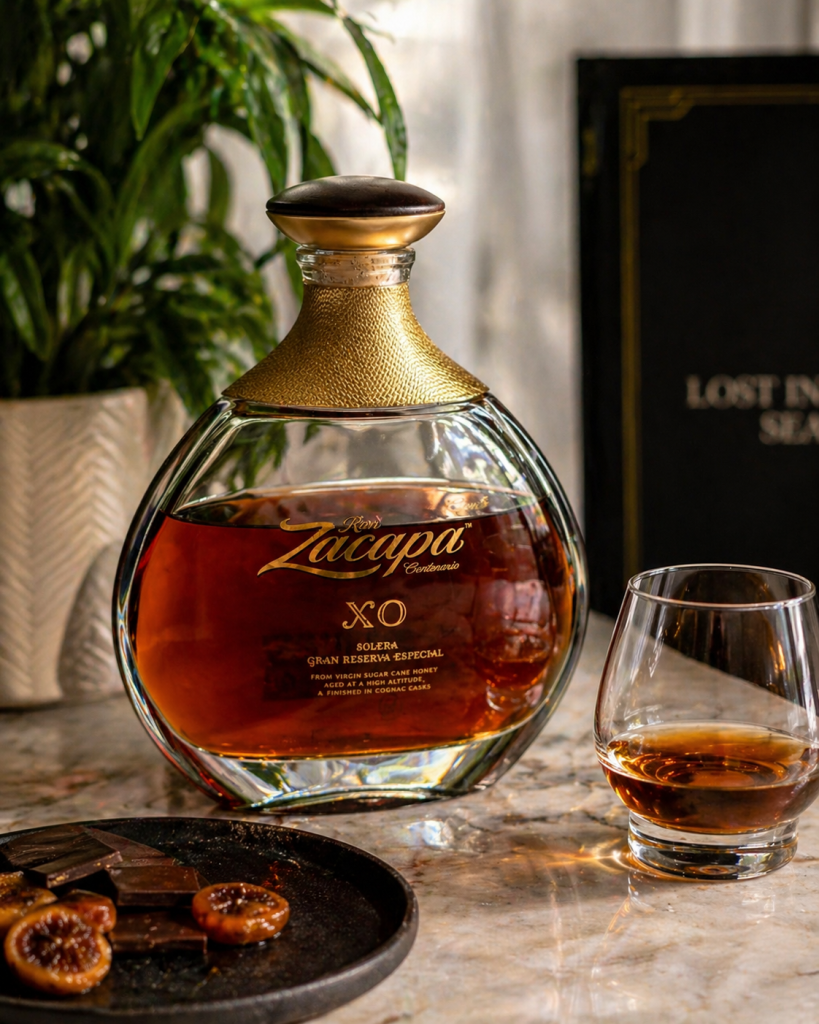
Ron Zacapa XO Neat
The Comeback Nobody Announced
In the past year I’ve noticed something shifting. Rum is making a comeback — a burgeoning one, and one that feels less like a trend and more like a correction. A handful of brands are pushing through with genuine intent. Flor de Caña, which I’ve used extensively in my projects, is delicious in the way that only well-aged agricole-adjacent rum can be. Camikara — an Indian cane spirit of genuine ambition — crossed my path multiple times when I was judging their annual competition alongside mixologists from across the country. The category is waking up.
It was at a duty-free, passing through, that I came across a rum section I hadn’t expected to stop at. A row of large, square black boxes — striking gold embossed lettering: Ron Zacapa XO. I didn’t think too hard about the price — a cool ₹19,000 at the counter — and on impulse, I thought: let’s try it.
The day I opened it changed my opinion about sipping rum entirely.
The House and The Highland
Ron Zacapa is Guatemalan — and the geography matters more here than with almost any other spirit I can think of. The rum is aged at 7,544 feet above sea level, where the temperature holds at a steady 62°F. The lower atmospheric pressure at altitude does something specific to barrel ageing — it intensifies the infusion of flavour from the wood, accelerating the conversation between spirit and cask in ways that lower-altitude ageing simply cannot replicate. Zacapa calls this facility their House Above the Clouds. It is not marketing hyperbole. It is, quite literally, what it is.
The other distinction is in the base material. Most rum is built on molasses — the byproduct of sugar refining, dark and heavy with residual sweetness. Zacapa uses only the first press of sugar cane, known as virgin sugar cane honey — fresher, more delicate, with a natural sweetness that doesn’t carry the heaviness of molasses.
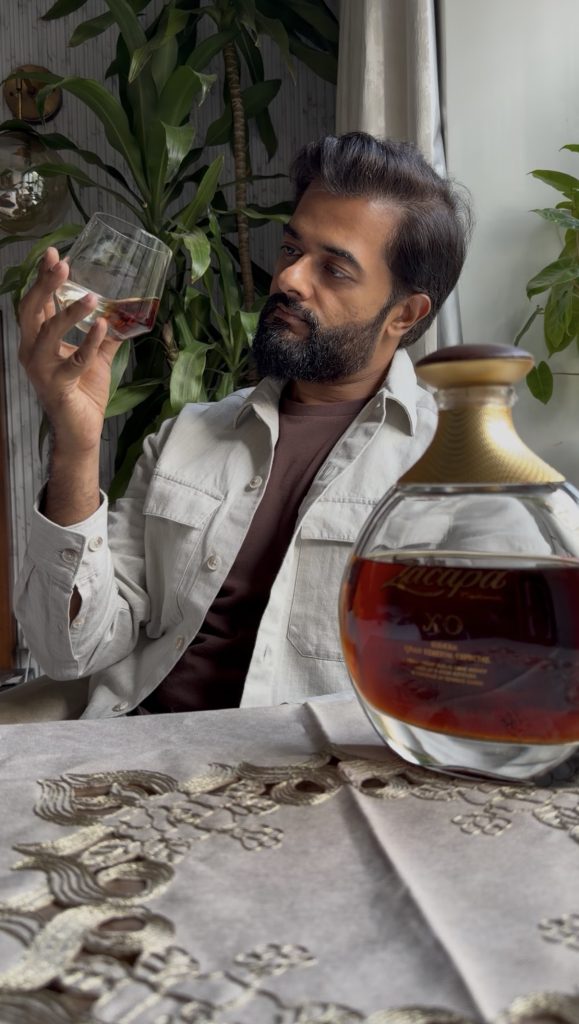
The Ron Zacapa XO
The Sistema Solera — Patience as Philosophy
If you want to understand what makes the Zacapa XO genuinely different, you need to understand the Solera system — and the best way I can explain it is through food.
Imagine a sauce that has been reducing for twenty-five years. As you use it, you add fresh ingredients to the pot — but the pot is never emptied. The new absorbs the old. The old educates the new. Over time, what you end up with is something no single vintage could produce — a layered, accumulated complexity that carries the DNA of every ingredient that ever passed through it.
That is the Sistema Solera. Rums aged between 6 and 25 years are blended as they age through a sequence of barrels that previously stored robust American whiskeys, delicate Sherries, fine Pedro Ximénez wines, and are finished in French oak casks that previously aged Cognac. Each barrel leaves something behind. The XO expression takes this further than the standard Zacapa 23 — with an additional finishing stage in French cognac oak that adds a final layer of dried fruit, warm spice and extraordinary length.
It is, as I said in the reel, bottling the flavours of continents together. That line wrote itself the first time I nosed the glass.
What’s In The Glass
The colour alone earns the stars. Deep mahogany with red and burgundy hints at the rim — thick, oily legs forming slowly on the glass after a swirl, indicating the viscosity that only serious age and careful blending produces.
On the nose — burnt caramel, toasted oak, dry roasted nuts, a distinct marzipan note and orange peel underneath everything. There is a sherry-driven quality that will immediately speak to single malt drinkers — that same dried fruit depth, perhaps the many iterations it met.
On the palate — dark chocolate hits first up. Then dried fruit: date, prune, fig. Then the spice builds slowly — clove, vanilla, cinnamon — warm rather than sharp, you can feel the spice as it slides down your throat. A warmth that coats the mouth without burning, an oiliness that lingers, and then somewhere in the mid-palate, nutmeg and milk chocolate making an appearance that you don’t see coming.
The finish is long. Genuinely long. Honey, warm oak, and something faintly cognac-driven that keeps evolving for several minutes after the glass is down. You could sit with a single pour for an hour and find new things in it. I have.
A note for the technically inclined: this is bottled at 40% ABV, which some rum purists find conservative for a spirit of this complexity. They are not wrong — a slightly higher ABV would let more of the character breathe. But at 40% it remains approachable, and for the Indian market where sipping rum is a new conversation, that accessibility is probably the right call.
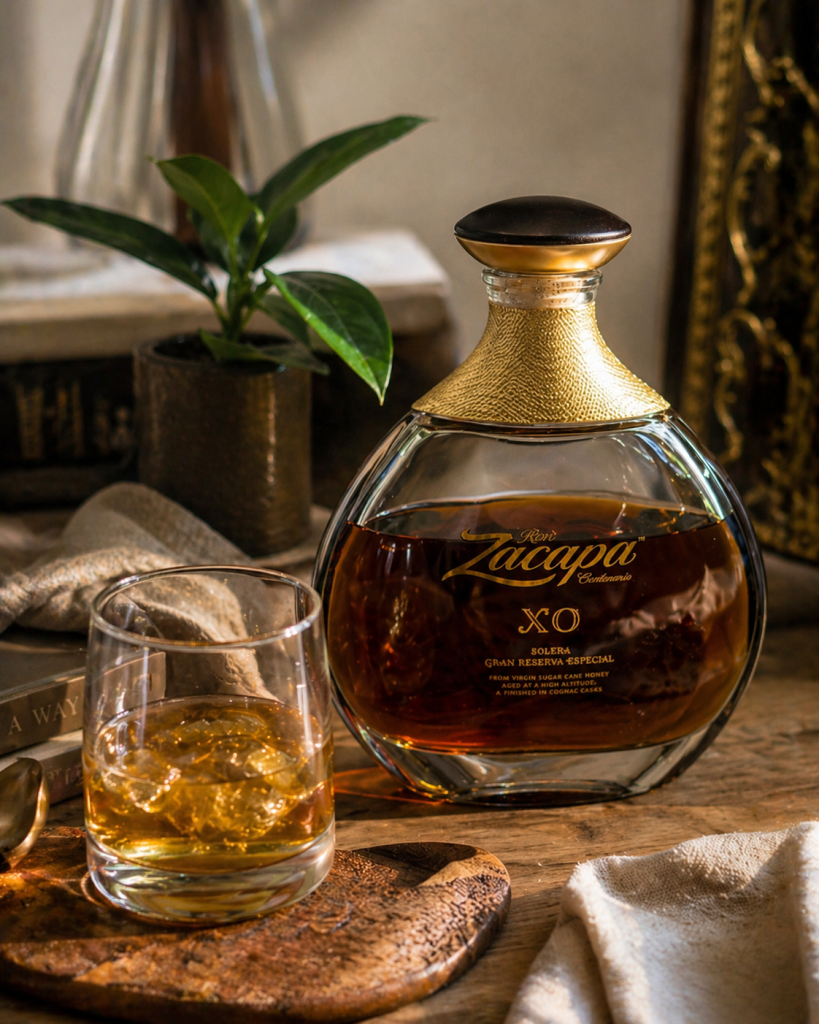
Ron Zacapa XO on Ice
How To Drink It
Neat. Always neat, at least the first time.
Use a tulip-shaped nosing glass if you have one — the kind you’d use for a single malt or an old fashioned (round bottomed) glass with a slightly tapered-in rim. It concentrates the aromatics toward the nose in a way a straight up tumbler simply cannot. If you insist on ice, use one large cube rather than several small ones — it chills without diluting too quickly, and gives the rum time to open up as it warms slightly from your hand.
Do not mix it. I say this without judgment — I understand the impulse, and I understand that fifteen thousand rupees++ (reduced over time due to tax levys) is a serious commitment for a bottle you then pour over cola. But the Zacapa XO is not built for dilution. It pairs beautifully with dark chocolate — 70% cacao or above — and if you are a cigar person, the pairing with a medium-bodied smoke is as close to a perfect evening as I can construct.
The India Argument
Here is what I believe: luxury rum in India is where single malt whisky was approximately a decade ago. A category that existed, that had its adherents, but hadn’t yet broken into the mainstream consciousness of the serious drinker. And then something shifted — the education caught up, the availability imp. Are we facing this as a surfacing trend?
Available via Duty Free.
Full technical details and tasting notes above.
This post contains personal opinions and tasting notes based on my own experience. While I am part of the hospitality industry and a food & spirits expert — I do drink thoughtfully and writes honestly about it.
The Ron Zacapa XO was purchased personally. This is not a sponsored post.
The consumption of alcohol is subject to legal drinking age requirements in your state. If you are below the legal drinking age applicable in your region, this content is not intended for you. Please drink responsibly.
Nonchalant Gourmand does not encourage excessive consumption of alcohol. All references to spirits on this website are intended for an adult audience of legal drinking age only.

Nikhil Merchant
Hospitality Writer | Culinary & Bar Consultant | Restaurateur | Brand Evangelist