
x
N
G
Atelier Materi : When Oud Met Burgundy
Atelier Materi‘s Burgundy Oud Extrait de Parfum — and why a French perfumer did what no one expected with the oldest ingredient in the world.
Bombay is chaos by design. Not the broken kind — the functional kind, where a spectrum of neighbourhoods press up against each other in what can only be described as a organised cacophony of people and places. The city has always understood specialisation. A street for fabric, a lane for hardware, a market for spices. In the eastern parts of the city particularly, you’ll find bazaars that have catered to the same specific need for generations — and the residents who depend on them have never needed to look further.
One of those specialisations, and the one that fascinated me most as a child, was perfume.
I roamed these markets with cousins and then friends, finding the small things you’d never stumble upon in a general store. But it was always the perfume vendors who stopped me. They’d sit cross-legged on white mattresses in crisp white kurta-pyjamas, kohl-lined eyes tracking you with the particular patience of someone who knows you’ll come back. Behind them, small coloured glass phials would catch the light — dozens of them, each holding a different concoction from a lineage of recipes that stretched back centuries.
These were attars. And their history in India is considerably older than the city I grew up in.
A Brief History of Attar — and Why It Matters
The word attar comes from the Persian itr, meaning fragrance or essence. Attars reached India through trade and cultural exchanges during the Mughal era, between the 16th and 18th centuries. The Mughals, known for their patronage of art and luxury, brought Persian perfumery traditions and combined them with Indian botanical knowledge.
Court historian Abu’l-Fazl ibn Mubarak chronicled Mughal emperor Akbar’s regular usage of attar and incense sticks in the Ain-e-Akbari — a 16th-century document. Akbar had an entire department of perfumery so that he and his successors could keep themselves well-scented in a region where the hot climate demanded it. There is also the story of Emperor Jahangir’s wife, Empress Noor Jahan, who is said to have bathed in water perfumed with rose petals — and whose name became synonymous with fragrance refinement in the Mughal court.
The technique itself — hydro-distillation of aromatic plants fixed into a base of sandalwood oil — was already ancient by the time the Mughals arrived. The oldest known still for aromatic plants was found in what is now Pakistan and dates to at least 5,000 years ago. What the Mughal era gave India was not the practice of attar-making but its elevation into an art form — and a trade that would eventually make cities like Kannauj in Uttar Pradesh the fragrance capital of the subcontinent, often dubbed the “Grasse of the East.“
Those vendors in East Bombay were the inheritors of all of that. They probably didn’t think about it in those terms. Neither did I, as a child pressing my wrist toward a small glass phial.
The Smell I Kept Coming Back To
Among the many things those vendors would offer — rose, jasmine, sandalwood, vetiver — one smell always stood apart. Sharp. Dense. Almost overwhelming on first encounter, but with a depth underneath that kept pulling you back. I found out later it was oud.
Oud comes from a tropical tree of the Aquilaria genus. When infected by a fungus, the tree produces a precious resin: oud wood, also known as agarwood or aloeswood. This resin is rare — only one in a hundred trees naturally contains it. What the tree is doing, essentially, is defending itself. The infection triggers a response, and the resin that forms over years — sometimes decades — in the heartwood of the tree becomes one of the most complex aromatic materials on earth. Only around 2% of wild Aquilaria trees ever produce agarwood — which is the fundamental reason for its extraordinary rarity and cost.
With thousands of years of known use, and valued across Hindu, Buddhist, Muslim and Chinese cultures, oud is prized in Middle Eastern and South Asian cultures for its distinctive fragrance, used in colognes, incense and perfumes. In the attar shops of East Bombay, it sits in those coloured glass phials beckoning you with its scent. seductively.
The House — Atelier Materi
Atelier Materi is a French fragrance house founded by Véronique Le Bihan — architect, designer, perfume obsessive. The house’s philosophy is unhurried and uncompromising: recognised by the Fragrance Foundation, they embody a new vision of luxury — authentic, minimalist (this instantly appeals to me), and guided by an ethical, responsible approach. Le Bihan has said that her fragrances are released when they are ready, not when a marketing calendar asks for it. In an industry that runs on launch cycles and seasonal collections, that is either an act of creative conviction or considerable commercial courage. Probably both.
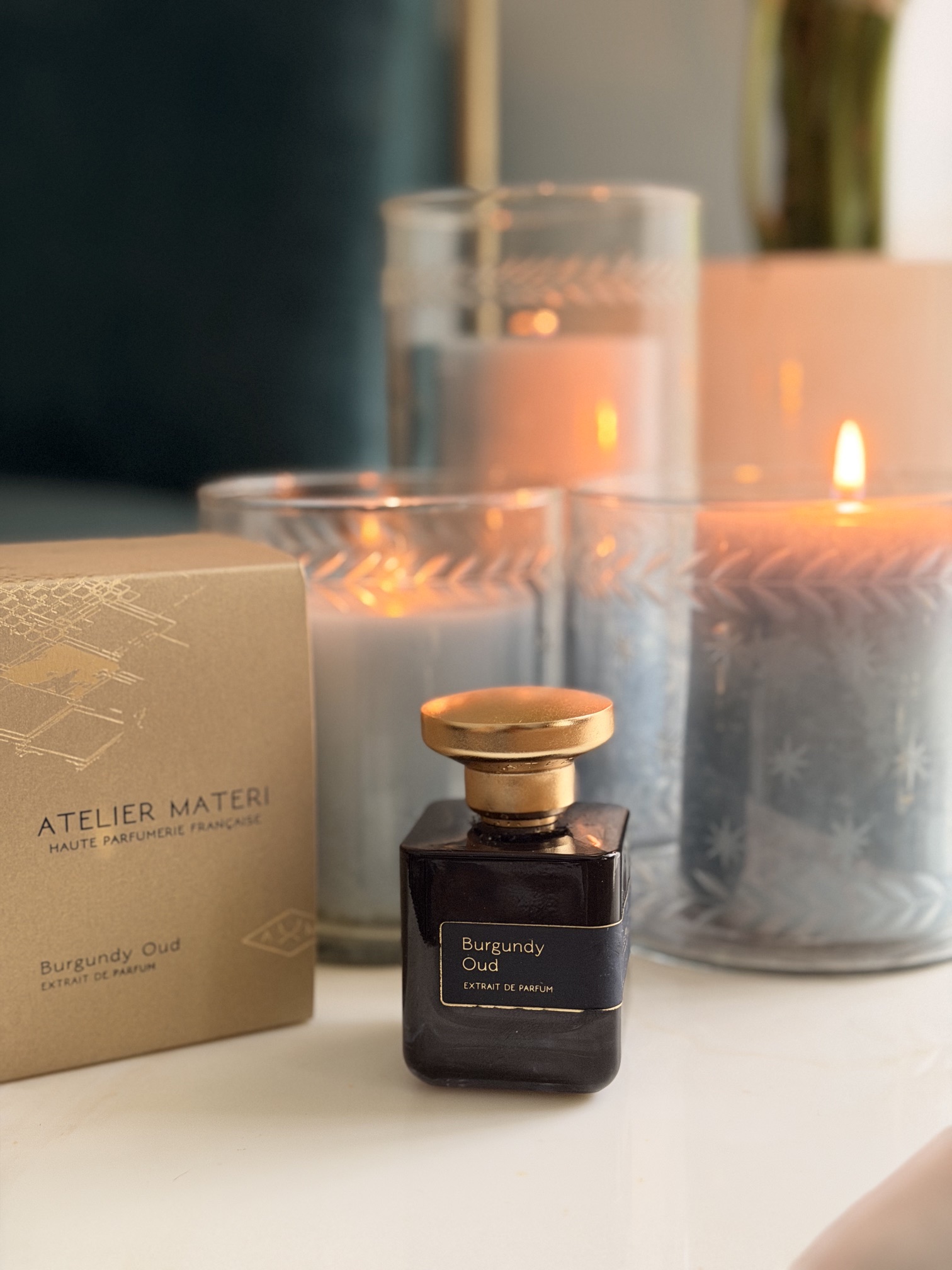
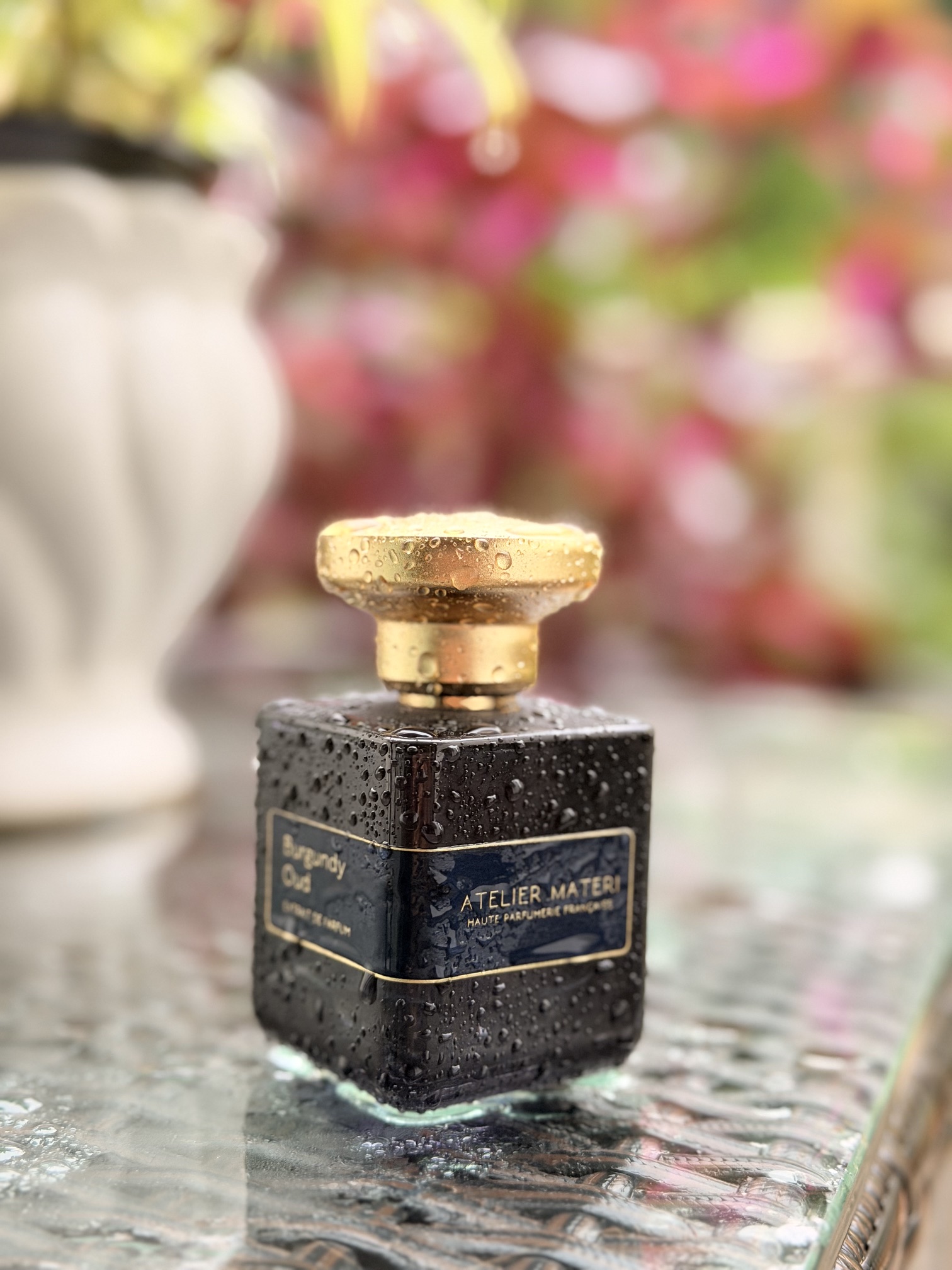
The bottles are objects in their own right. Inspired by the landscapes of Brittany — hand-blown deep blue glass, with a cap made of concrete that is hand-poured, hand-polished and hand-patinated to resemble a pebble smoothed by ocean waves. Before you smell anything, you are holding a piece of art and craft. The weight of it instantly changes the way you look at this perfume, and where bottles for these elixirs have evolved to.
Burgundy Oud — What They Did With It
The fragrance was created by perfumer Céline Perdriel. The brief, as far as one can infer it, was essentially: take oud — the most ancient, the most Eastern, the most recognisable ingredient in perfumery — and create something unexpected with it. What Perdriel reached for was Burgundy blackcurrant.
It is, on paper, an unlikely pairing. Oud is dark, resinous, woody, ancient. Blackcurrant is sharp, fruity, almost tart — a note more at home in a summer garden than in an attar shop. But the logic reveals itself on skin. The blackcurrant bud absolute — paired with Guatemalan cardamom and bergamot at the top — lifts the oud, gives it air, strips away the heaviness without removing the depth. At the heart, geranium, magnolia and davana add a velvety smoothness. And then the base: oud, amyris, leather. The ancient part remains uncompromised and infact is presented so differently.
The founder described it as “a bridge that connects the East and the West.” That phrase is used often enough in fragrance to have become a cliché. Whilst here it holds.
My First Encounter — In the Rain
I opened this bottle on a monsoon afternoon in Bombay. Sealed box, plastic still on it, the rain coming down on my terrace. It felt like the right conditions for an oud fragrance — the rain does to a city what a good oud does to the air around you. It washes away the acrid and the ordinary and leaves something earthy, vegetal, refreshed underneath.
The first spray was not what I expected from something called Burgundy Oud. It was delicious — immediately fruity, the blackcurrant forward and bright, the cardamom giving it warmth without spice. Rich and exquisite without being heavy. And then, as it settled, the oud bloomed in all its glory. Not the sharp overbearing oud of those glass phials in East Bombay — but this one is refined, so grounded and shows itself in its truest form. The old world material given a new world feeling.
It makes people’s heads turn. And its one of those silent luxury fragrances you almost feel like you’ve layered two scents together. I am positive it makes them think they’ve entered a different realm unknowingly.
Where to Find It
Atelier Materi is available in India through select niche fragrance retailers like Scentido. The Burgundy Oud Extrait de Parfum is concentrated at 30% — two sprays is more than enough. The bottle, as noted, is an object worth owning. Approx INR 26,700/-
Nikhil Merchant
Hospitality Writer | Culinary & Bar Consultant | Restaurateur | Brand Evangelist