
x
N
G

Khopra Pak
A Coconut Sweet from My Nani’s Kitchen
The coconuts for this sweet come from trees my mother planted in Bombay. She moved here after marriage and brought a little of Goa with her, and some of it was coconut. Every Diwali, the fruit of those trees goes into one sweet. Khopra Pak. It is my nani’s recipe, passed to my mother and now to us.

Nani’s Cottage on the Mandovi
My earliest Diwali memory of this sweet is of my nani making it. She made it whenever we visited, Diwali or not, because we asked her to, and she was always glad to.
Her cottage stood on the banks of the Mandovi, the tidal river that runs through Goa to the Arabian Sea. Along its banks the mangroves and coconut palms grow close, and ferries cross at the wider stretches. On her grounds there were about 200 trees, and the harvest was strong enough that coconut was never rationed in that kitchen.
We ate it hot off the stove sometimes. She would snicker at how much we loved her cooking. There was a certain love in that flavour that is hard to recreate, and I think I am coming close.

The Trees at Home
Our trees crop about once a quarter, and a harvest gives us 200 to 300 coconuts, roughly fifty from each tree. A coconut man comes to bring them down. They sort into three kinds. Tender coconuts with water and thick, fleshy malai. Mature ones for fresh grating, for chutneys and the like. And the rest, which are left to dry for oil, and for Maharashtrian and Konkani cooking.
The malai on these is fleshy and sweet, and that matters here. A sweet with this few ingredients has nowhere to hide a poor coconut.
Why I Send It
Every year I send gifts that carry some meaning from my life. A box of Khopra Pak is a slice of that life at an auspicious time, closer to a remembrance than a present. It is pure, and it tastes different from a sweet bought in a shop, because the same care goes in that went into my nani’s. Hers went in then, and mine goes in now.
Not everyone gets a box. Those who do tend to be the ones it was meant for, and it finds its way into their homes. This year each box went with a short note saying whose recipe it is and where the coconuts come from.
A Few Notes on the Sweet
Most of India knows it as nariyal barfi or khopryachi barfi. In the Konkan and Maharashtra it is Kopra Pak. In North India it is also served as prasad after Janmashtami. One account credits Konkani cooks with stumbling on it by mixing grated coconut with sugar. I treat that as folklore, since the sweet has few documented origins.
There is no ghee or oil in this version. Fresh coconut carries enough fat of its own, and it releases that as it cooks. The cashew powder is another Goa link. Cashews are not native to India, but they are now widely grown along the west coast, Goa among the places, which is why they sit comfortably in a Goan sweet. We powder ours at home, and the one rule is that they must be unsalted.
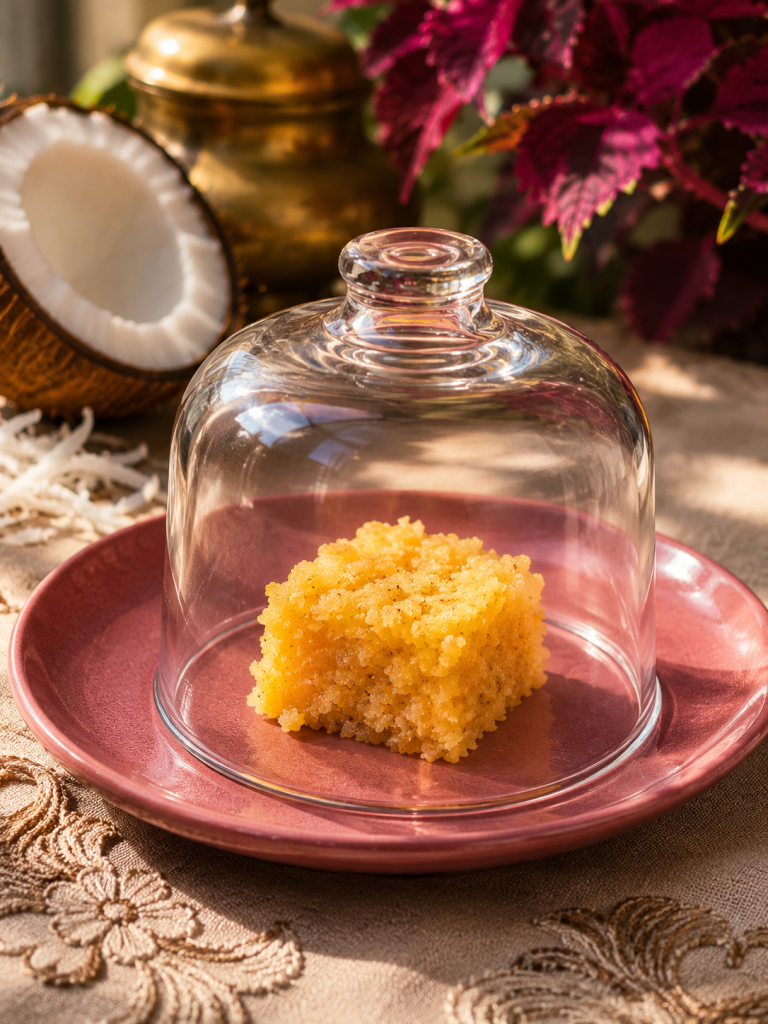
Khopra Pak — My Nani’s Fresh Coconut Sweet
Makes one 24-inch thali, or about two 12-inch thalis. The ratio is the recipe: for every cup of fresh grated coconut, use ½ cup sugar and about ½ cup milk, just enough to soak the coconut through.
Ingredients
– 4 cups fresh grated coconut, white flesh only
– 2 cups sugar
– About 2 cups milk, just enough to soak the coconut (roughly the same volume as the sugar)
– 15 saffron strands, crushed with a pestle in a little hot milk [confirm: ___ tbsp milk]
– 4–5 cardamom pods, skinned and crushed (adjust to taste)
– ¼ cup cashew powder, unsalted
– Rose petals or dried fruit to finish, optional (I leave it plain)
You will also need
– A non-stick pan, a steel thali, and a small metal plate
Method
1. Grate the coconut well, using only the white flesh.
2. Crush the saffron strands with a pestle in a little hot milk and set aside.
3. Put the coconut, sugar and milk into a non-stick pan. Drop a small metal plate into the vessel, which stops the milk from burning at the bottom.
4. Cook on high heat until it starts bubbling, then turn the heat down.
5. Keep cooking, stirring every now and again, until the mixture turns thick and most of the milk has evaporated. This takes 45 minutes to an hour, or a little longer.
6. Stir in the cashew powder to thicken it, then the saffron milk and the crushed cardamom. Cook for another 5–8 minutes on medium heat.
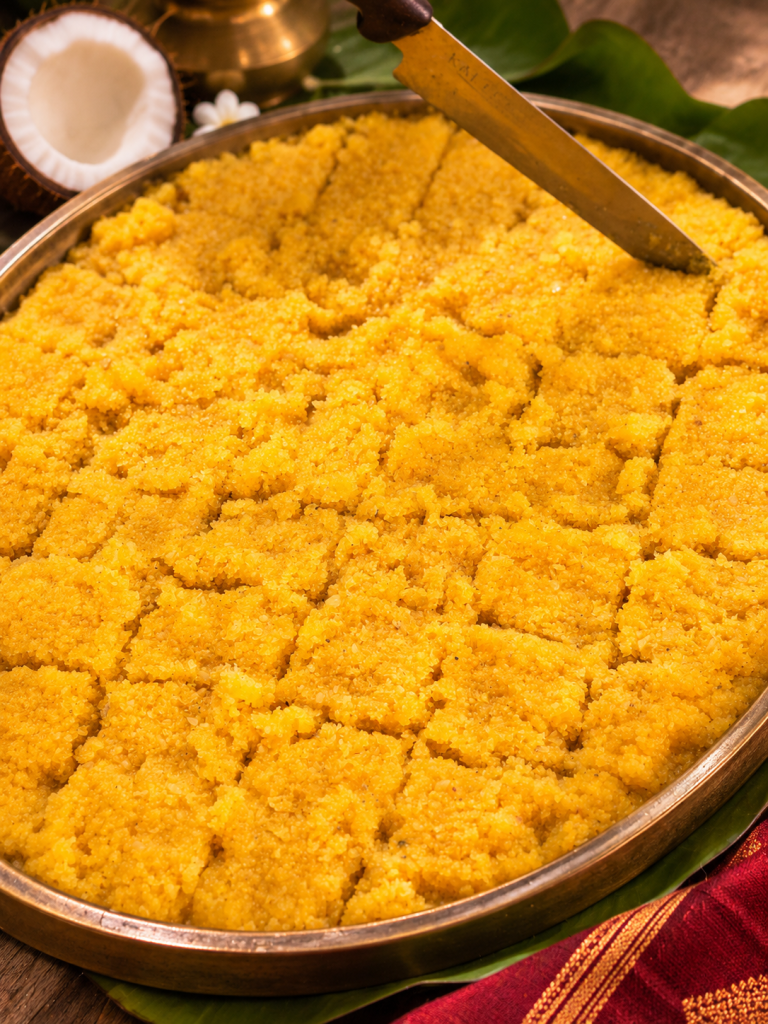
7. Tip the mixture onto a steel thali and spread it to about an inch thick. Let it cool.
8. It will not set hard, but it becomes sticky enough to cut into squares. Cut, then scoop into a box or flatter boxes and keep in the fridge.
Notes
On the coconut: Use fresh, always. The dehydrated coconut sold in shops is not the same. Invest in some fleshy ones and grate the white part well.
On stirring: My nani’s instruction was to keep stirring every now and again, and to drop a small metal plate into the vessel so the milk would not catch at the bottom.
On texture: The texture is the hard part, and it can be managed. Mine is soft and malleable. If you want it firmer and easy to pick up, like a barfi, add more cashew powder [confirm: roughly how much more?] until it holds.
On storage: It keeps well in the fridge [confirm: how many days or weeks?]. Cold it stays firm.
On serving: I like it warm and I like it cold. You can make that choice.
Some things never quite leave home. They take root, and four times a year someone comes to bring the coconuts down.

Nikhil Merchant
Hospitality Writer | Culinary & Bar Consultant | Restaurateur | Brand Evangelist