
x
N
G
Where the Forest Takes Over: Three Days at Aramness, Gir
Gujarat had always been on the list — a bucket list of sorts – for years, waiting. I knew enough about it to be curious: the salt flats of the Rann, the step-wells, the Kathiawadi hospitality that people speak of with the kind of warmth usually reserved for Rajasthan.
What I hadn’t fully anticipated was that my first time in Gujarat would be spent not in a city, but deep in the edge of one of the most significant forests in the world — invited to a property that I’d heard about in the right circles for a while now.
Aramness. The name itself is a clue — a portmanteau of the Gujarati words aram, meaning rest, and ness, meaning hamlet. A peaceful village. And that is precisely what it is, except that very few peaceful villages come with private plunge pools, a naturalist on call, and the last wild Asiatic lions on earth as your neighbours.
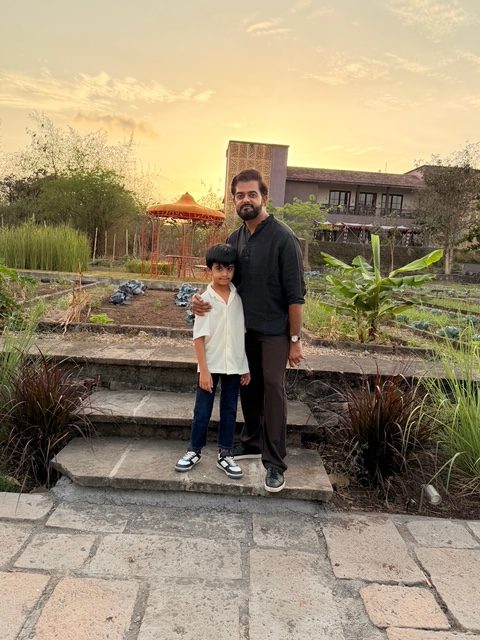
I came, as I often do, solo. Except this time with a plus one — my nephew, who I thought deserved to see a lion in the wild rather than on a screen. It turned out to be one of the better decisions I’ve made in recent travel memory.
The Last Lions
Here is a fact that should stop you in your tracks: the Gir forest in Gujarat is the only place left on this planet where you can see an Asiatic lion in the wild. Not Africa. Not a zoo. Not anywhere else. Just this one ancient stretch of teak and acacia in Saurashtra, and fewer than 900 of them remain.
The history of how they got here — or rather, how they almost didn’t — is sobering. By the early twentieth century, relentless hunting had reduced the Asiatic lion population to roughly twenty individuals. Twenty. The species teetered on the absolute edge of extinction, saved in no small part by the Nawab of Junagadh, who imposed protections on his territory at a time when the colonial instinct was still largely to shoot first. In 1965, Gir was declared a wildlife sanctuary. Today, after decades of rigorous conservation, the population has grown to nearly 900 — one of India’s great wildlife recovery stories, and quietly, one of the world’s.
The Asiatic lion is also distinct from its African cousin in ways that matter. Stockier, with a sparser mane that leaves the ears always visible, and a longitudinal fold of skin along the belly that is unique to the subspecies. They are, by all accounts, entirely unbothered by human presence — a quality that makes a sighting here feel like a dedicated acknowledgement.
Gir also manages itself with an intelligence that I hadn’t expected. The park is divided into six zones, with no more than six jeeps permitted per zone at any given time. Safari slots now need to be booked forty-five days or more in advance. There is none of the chaotic convoy feeling that can undermine a wildlife experience — just small groups, trained naturalists, and a forest between you and peace.
Aramness, Gir 2026
The Property: Built from the Ground Up, Literally
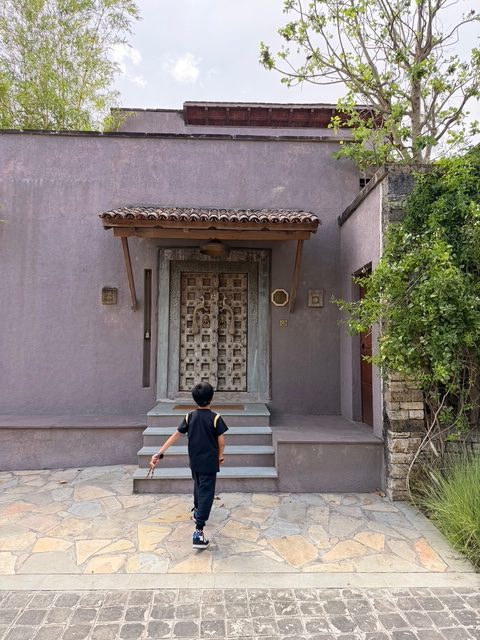
What stands at Aramness today was, not long ago, a barren working farm — no trees, no wildlife, no buildings of note. The founders, including Jimmy Patel, a conservationist and wildlife photographer, didn’t just build a lodge. They planted five thousand indigenous trees. They dug watering holes. They commissioned carved doors from old havelis across the region, had brass door handles cast in the shapes of Gir’s wildlife, and sourced local sandstone that, as one of the architects noted — the patina ageing gracefully.
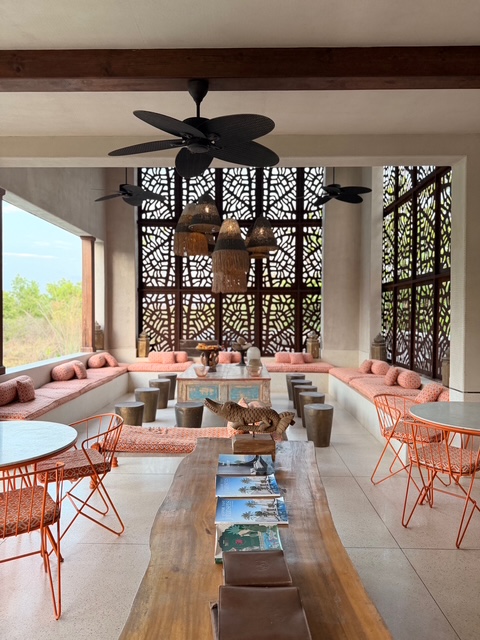
The design language — conceived by Nicholas Plewman Architects and Fox Browne Creative — draws from the characteristic villages of the region, with a central cobbled street flanked by courtyard homes. The eighteen kothis (the word simply means bungalow, or small home) emerge from winding alleys of planters and courtyards, each one a double-storey building with a sitting room, a generous bathroom, an outdoor shower, and a private plunge pool. The latticed screens throughout the property are modelled on the teak leaf at the end of its life — where it once absorbed light, it now lets it through.
On entering, I was greeted by the entire team — including the General Manager — and introduced almost immediately to our butler, who had clearly done his homework (this is meted out to every guest). Traveling with my nephew meant that certain considerations were already in place before I’d asked for them. That is the particular quality of service that Gujarat seems to carry in its cultural DNA.
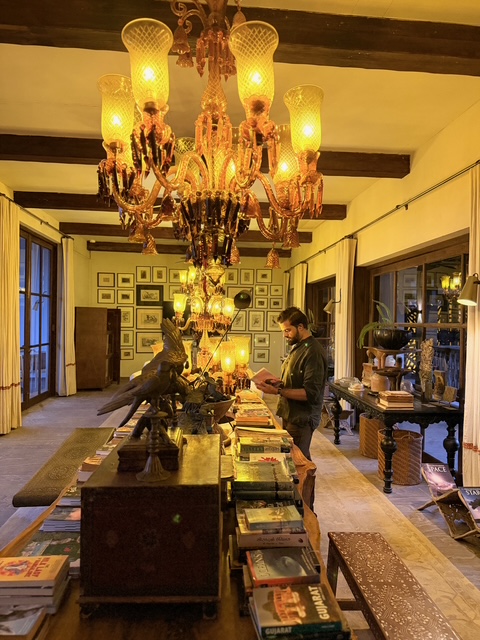
The Library
Slowness as a Design Principle
The wellness offering at Aramness doesn’t announce itself. It begins with a consultation — a proper one, with an in-house naturopath using state-of-the-art equipment to map your patterns and suggest a routine for your stay. From there it’s a breeze (and at your pace): yoga sessions that make sense in the context of a forest, sound healing at the spa that I found unexpectedly arresting, private guided walks, and a general philosophy of leaving you entirely alone when you want to be left alone — while ensuring someone is always nearby when you don’t.
My mornings settled into a particular shape: coffee on the terrace, the chital calling somewhere in the tree line, a slow drift toward the private pool with absolutely no agenda. There is a version of luxury that is about accumulation — of experiences, activities, things to report back. Aramness offers the opposite. It gives you the conditions for genuine stillness, and trusts you to know what to do with it.
Between the stillness, though, there are layers worth finding. A resident potter who can initiate you into the quiet logic of the wheel. An evening in the games room — my nephew’s undisputed highlight of the entire trip, and a reminder that the best properties think about the full spectrum of a guest’s day, not just the headline experiences. The gym. The edible gardens, where much of what finds in well put together dishes, at your table was growing within sight of your kothi that morning.
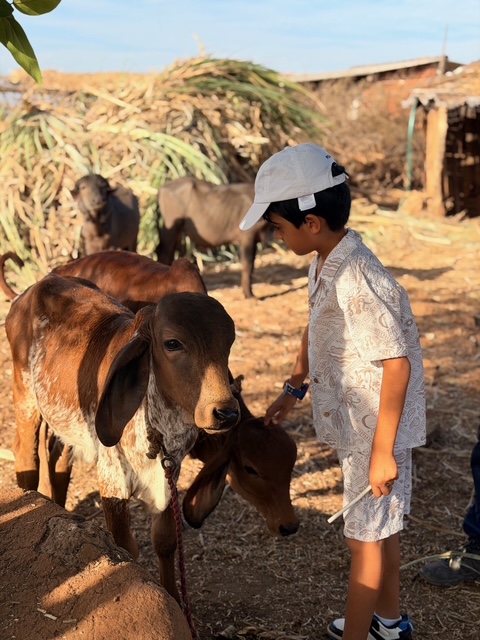
The Maldhari, and the World Beyond the Lodge
One of the most affecting experiences of the stay had nothing to do with the lodge itself. A visit to a Maldhari family — the semi-nomadic herders who have lived inside and alongside the Gir forest for generations — offers a perspective that no amount of excellent interior design can replicate. These are communities whose livestock graze alongside lions, whose entire way of life has been shaped by and around the forest. Their coexistence with the Asiatic lion is, depending on who you ask, both the secret of Gir’s conservation success and its ongoing complexity. Sitting with them, in their ness, watching their cattle move through the late afternoon light — it put everything else in quiet relief. PS: The infamous Gir cows and the chai (made from fresh milk from these very cows) we had at their home was exceptional.
Sixty percent of Aramness’s staff come from the neighbouring village of Haripur. These are not decorative gestures toward community — they are structural commitments. The people who work here grew up alongside this ecosystem. That quality of care, the sense that this place genuinely matters to the people who run it, is something guests notice without always being able to name it. I noticed it.
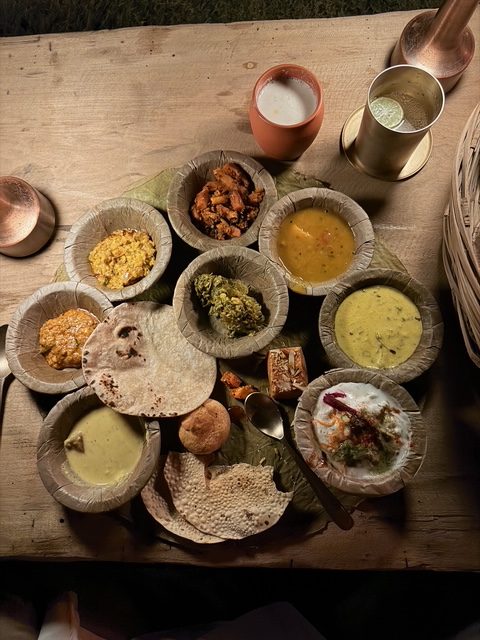
Kathiawadi Meal
The Table
The food at Aramness is Kathiawadi at its core — lies in the flavours of Saurashtra, built from ingredients that are largely grown on the property or sourced locally. Meals can be taken in the courtyard, on a roof terrace, in the greenhouse — the architecture of dining shifts with the time of day and the mood of the guest. It is farm-to-table in the truest sense: the vegetable patch, well half an acre, should be a staple should a resort or retreat have space.
One evening, after a long day in the forest and the games room and approximately four rounds of something competitive that I was not winning, my nephew negotiated — firmly and without ambiguity — for pizza and fries. The kitchen obliged without a flicker. That, too, is luxury: the absence of rigidity.
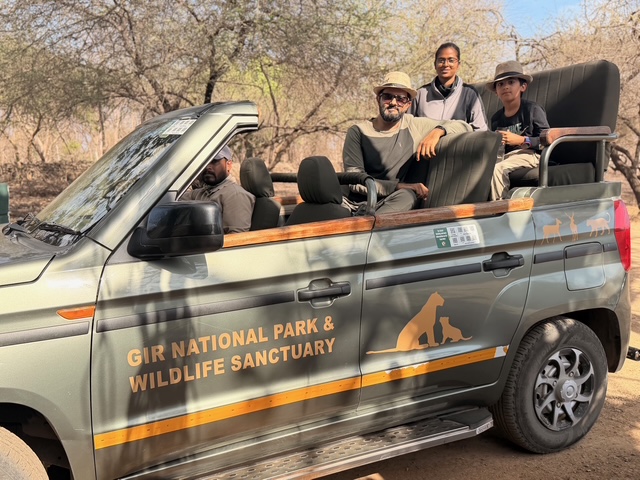
Into the Forest
We went in with low expectations, which is the only honest way to approach a forest. Wildlife does not perform on your whim, and Gir has enough repeat visitors who came away lionless to make humility the correct posture. Our naturalist said as much, gently, before we set out.
We saw nine lions.
Including a lioness with three cubs, basking in the warm afternoon light being a queen of her zone. My nephew, who had been a model of restless energy for most of the trip, went completely still. I watched him watch her. That silence — the particular quality of it — is not something I will easily forget.
The drive also brought leopards, spotted chital, nilgai, the flash of a Tickell’s Blue Flycatcher, the territorial squawk of a red-naped ibis. The forest is not only about the lions, though the lions are — undeniably, entirely — why you come. Everything else is the context that makes the sighting mean something. A forest this biodiverse, this carefully protected, produces that effect: each creature in its right place, the whole thing humming with a logic that predates us by millennia.
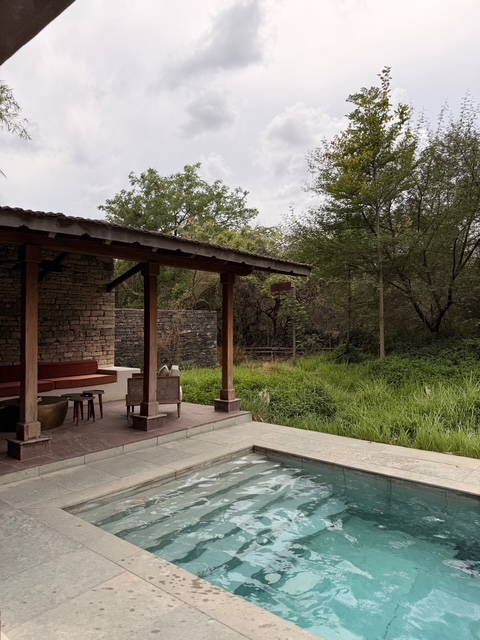
The Understated Luxury We Don’t Give Enough Credit
I’d heard Aramness described, before I visited, as understated luxury. I now understand what that means, and why it is perhaps the most precise compliment a property can receive. Luxury should not be describable, it should be felt — in the quality of the linen, the intelligence of the service, even the detail of a carved door handle shaped like a Gir fox. In the fact that when you want solitude, you have it completely. In the fact that a forest this significant is right there, managed with genuine care and seriousness, waiting.
There are properties that suit a certain kind of traveler — the kind who finds more pleasure in a morning of silence and a serious cup of coffee than in a packed excursion schedule. Who travels not to accumulate but to recalibrate. Who understands that the most memorable thing about a great trip is rarely the most obviously spectacular part.
Aramness is built for that traveler. And Gir, with its ancient forest and its improbable lions and its pastoral Maldhari culture and its particular, unhurried light — is a place that I suspect stays with people for a long time after they leave.
It is staying with me.
Practical Notes
Aramness Gir sits in the buffer zone of Gir National Park, Gujarat. The nearest airports are Rajkot (3 hours), Diu (2.5 hours), and Ahmedabad (7 hours), all well connected from Mumbai and Delhi. The property has 18 kothis, all with private pools. Rates include all meals and one game drive per day. Safari slots in Gir now require booking 45+ days in advance — plan accordingly. The best season runs October through March.

Nikhil Merchant
Hospitality Writer | Culinary & Bar Consultant | Restaurateur | Brand Evangelist