
x
N
G
Chiak Si Hock
Eat brings in prosperity. The literal translation of Chiak Si Hock; a term proudly used in Penang when referring to food. Our last lap of the trip was in Penang and rightly so a perfect place on the itinerary as Penang is called the Food Capital of Malaysia. The Penang Tourism Board was our host and we were treated like royalty right from the moment we stepped onto Penang land. Our guide, Anil or should I say mentor was the perfect accomplice to the food trails chalked out for us in Penang. We could not have asked for a better person to show us around as he was as enthusiastic about food as our excited, ‘extra stomach for everything’ bunch. Anil is an Indian who is born and brought up in Penang and never been to India, but he made sure we did not miss a single spot in Penang as we made ourselves accustomed to the place.
Since we had docked at Swettenham Pier, Penang right after breakfast, Anil suggested we have a little tour of Penang which in a way would be a good exercise to take in the sights and sounds of the town’s popular hot spots. Intrigued as we were on spotting many food establishments in every nook and corner, it was inevitable that Penang was a bubbling, melting pot just like its famous Laksa and we were assured of being satiated at every step. We stopped by for lunch at ‘Hameediyah’ an extremely popular food joint, nothing fancy, but having one of the best made street foods available in town as well as their ever popular Murtaba (a lot like our baida roti). Murtaba is a wholesome dish with varied stuffing’s of your choice ranging from chicken, mutton to pork and eggs. It is much like a one dish meal as it comprises of a plump roti in which your stuffing is layered and doused with beaten egg and then shallow fried on a hot pan.
Well tucked in and stuffed like Murtaba’s after a heavy meal of Nasi Kandar (a mixed meal which contains meat curry of sorts, fried chicken, squid, fish roe, cubed beef and prawns served with plain or spiced rice), The word Nasi Kandar comes from the time when hawkers would carry Nasi (Rice) on their Kandar (shoulders), balancing the rice in baskets on one side of the pole and the accompaniments with curry on the other end. Some Fish Head Curry (Another popular Malay dish, which incidentally was first created by an Indian named Gomez in his Singaporean restaurant), now a delicacy meal in Malaysia and extremely flavorful with a full fish head and delicate curry surrounded by Okras, we had a small tour of Penang’s famous Blue Mansion in Georgetown. The Blue Mansion as it’s descriptively called due to its electrifying indigo blue façade (actual name being – Cheong Fatt Tze Mansion, after its owner) is Penang’s architectural wonder having a line of historical and cultural superlatives. It has opened its doors to visitors for guided tours as well as its charming rooms for exclusive stays, doubling up as a heritage hotel providing its select few guests with a royal treatment.
Don’t miss The Chocolate Boutique right next door to The Blue Mansion. We stopped by there to have a cup of coffee and were delighted to be escorted around their store with shelves after shelves of differently flavored fine chocolates which we were generously loaded with to taste. They were all ranging from fillings such as strawberries, blueberries, chilies, white, dark, nutty and even durian (an overwhelmingly smelly fruit of South East Asia, but high on flavor). They had a range of Coffees and Teas from the ever famous traditional tea called Teh Tarik to Tiramisu flavored Coffee.
We were escorted to the hotel short listed by The Penang Tourism Board. A forty five minute drive from Georgetown towards Batu Feringgi Beach, a popular on the coast tourist destination having a string of luxury hotels lining the virgin white beaches, had us standing in front of The Shangri-la Rasa Sayang, Penang. This place is a true vacationer’s delight. This is a beach touching property, vast in size and luxury personified. The ultra luxury spa “Chi” boasts of private villas for each guest, each one carefully secluded in foliage which could give a rainforest a run for its money complete with timber ramps leading up to the villas and Koi ponds. This place is surreal yet modern in every way possible and would keep us fresh, rejuvenated and pampered throughout our stay in Penang.
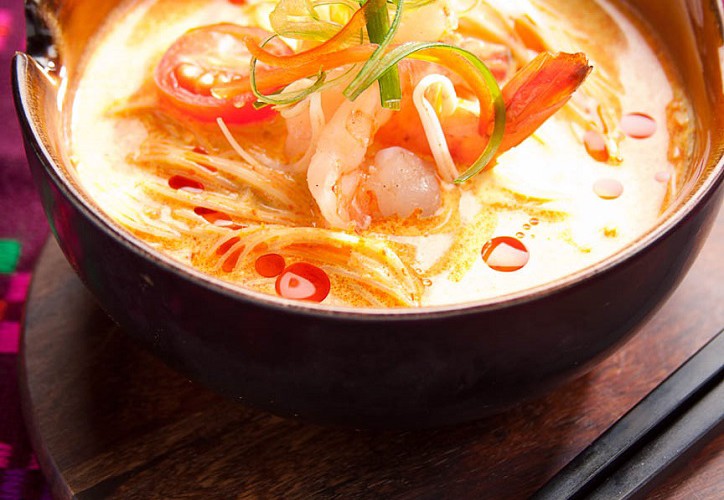
We had a stopover to eat traditional Penang Laksa at a hawker zone in Georgetown followed by Ice Kacangs (A shaved ice delight served with fresh fruits, noodles and jelly and topped with a variety of sweet syrups) to cool our system from the fiery hot Laksa. Traditional Penang Laksa or popularly called Assam Laksa (Assam meaning Tamarind in Malay) is a dish consisting of Noodles in a spicy base flavored strongly with fish sauce and sour tamarind. It’s traditionally served with a spoon of Prawn Paste (called Heh Koh) and is a one dish meal. There are other variations of Laksa such as the Curry Laksa called Mee Goreng which is coconut milk base and much lighter in flavor than traditional Penang Laksa.
Here is a recipe for a traditional Penang (Assam) Laksa adapted from various sources including the one made for me by Chef Praiwan at the Marriott Courtyard back in Mumbai. The curry was tried back home in its vegetarian version in which I avoided the fish paste but it still turned out excellent and quite close full of flavour.
Penang Laksa
Ingredients
- ½ Kg Mackerel Fish
- 500 gms Rice Vermicelli
- 2 liters Water
- 1 golf ball size tamarind (soaked in a cup of water)
- 2-3 peels fresh tamarind
- 1 small onions (minced)
- 2 tablsp Lemon Grass (minced)
- 1 tablsp Galangal / Ginger (minced)
- 6 red chillies (deseeded)
- 1 tablsp red chili powder mixed with a tablsp of water
- 1 tablsp Fish Sauce
- 1 tablsp Belacan Sauce*
- 2 tsp Sugar
- Salt to taste
Condiments:
- Shrimps (lightly stir fried with salt)
- Cherry Tomatoes (halved)
- Shredded Cucumber
- Shredded Cabbage Leaves
- Fresh Red Chili Flakes
- Sliced Onions
- Shredded Mint Leaves
- Traditional Prawn Paste (optional)
Clean the fish by de-scaling and removing the guts. Wash thoroughly.
Boil the rice vermicelli till well cooked, drain and toss in some oil to keep it separate.
In a large pot, heat water on high heat till boiling and add the whole fish. Simmer for about 7-8 minutes and drain but reserve the fish stock. De-bone the fish and cut it into smallish chunks (about ½ inch size) and keep aside
Transfer fish stock back on the stove and add the tamarind peels and a teaspoon of fish sauce with some mint leaves to boil. Turn the heat down to low and simmer. Add the fish chunks into the stock with the tamarind paste and simmer covered for about five minutes.
In a mortar and pestle, grind chillies, chili paste, galangal, lemon grass, onion and shrimp paste and make a coarse paste. Heat a small vessel with a little oil and sauté the grinded paste for a few minutes (ensure you do not burn the paste), Add this directly into the simmering fish and stock and cover and cook again for a few minutes. Lastly add the tamarind paste, fish sauce and season with salt and sugar. Taste for sourness, saltiness and sweetness and adjust accordingly.
To serve, place a handful of noodles in a large deepset bowl, spoon on the prepared Laksa fish curry paste, toss the condiments atop the dish and serve with a spoonful of traditional prawn paste (Heh Koh) or any South East Asian spicy condiment and you are set.
*Belacan Sauce is a fermented shrimp paste which is available in most Asian stores or custom notified shops. Look out for Shrimp Paste if the fermented version is not available.
Undoubtedly this dish is truly satisfying and might turn out lucky for you too considering eating brings in prosperity – Chiak Si Hock!
Few more Penang adventures followed by seven course meals on board as well as a special menu set out by the chefs of Shangri-la follow in the next couple of posts while this trip comes to an end…
The Malaysian Tourism Board & The Penang Tourism Board were warm and welcoming hosts. No better way of covering the culinary delights could be possible without their presence and they ensured we were never left hungry. Ark Holidays put up a good collaboration on all levels.
The Shangri-la Rasa Sayang Resort & Spa, Penang, made our stay a fantastic experience. Mr. Suleiman Tunku Abdul Rahman (The Director of Communications), a through gentleman, made us feel at home amidst the luxury of his resort and unasked pampering.
The main dish photograph: ‘Laksa’ is courtesy of the Courtyard Marriott in Mumbai. Chef Praiwan, the in-house Thai Chef from Thailand enthusiastically whipped this special dish even though it was not on the menu. The Courtyard Marriott is one place which you can also visit in Mumbai for authentic South East Asian Cuisine.
Nikhil Merchant
Hospitality Writer | Culinary & Bar Consultant | Restaurateur | Brand Evangelist