
x
N
G
The Wrap up Party
Love, unconditional love teamed with ego, unbreakable bonds and a sense of oneness inspired this post. There are two particularly sad events which happened in the era of liberation in Goa. One fabled to attract tourists and the other which was viewed by many a resident during liberation. The location “Dona Paula” now a major tourist attraction; has a history behind it which leaves you with an odd feeling in your heart. I always get a sense of déjà vu at this place for reasons best left un-probed and I only go there if I have to tour the city with a newbie.
Dona Paula had two incidents which took place, one a long time ago during the 16th century and the other quite recently in the 60’s when Goa was liberated. The area is marked by the ghosts of the incidents, till date. The incidents took place respectively at a pier jutting out into the restless sea unaffected by the lashings it’s subjected to day after day and the other around a non-descript statue of a man and a woman in pristine white stone with its hands missing, precariously mounted on the monstrous red rocks lining the area jutting out into the sea.
The first incident, a fabled legend reiterated by guides to unsuspecting tourists goes something like this; Dona a beautiful damsel wanted to marry Paulo a poor lad, the story weaves into many forms and eventually ends at the rocky pier where the statues are erected, with a heart wrenching ending of how both the lovers, unscrupulously denied their love, ended their life by jumping into the dangerous waters below, quite believable for an ignorant traveler. We all love drama at mythical spots and the wrap up of this story is nothing close to the untruth. In actual, Dona is a title given to a married woman in Portuguese. A very affluent lady by the name of Paula Amaral Antonio de Souto Maior who married a Spaniard in the 1600’s was called Dona Paula. Affluent as they were, they owned the property stretching from the Governors palatial house to Caranzalem. The statue is actually a sculpture of a philosopher Mr. Robert Knox and his wife and hence bears no relevance to the fable or the place.
The stories are similar in a matter of saying but don’t intertwine except for the place of their occurrence. The jutting pier holds the angst and egos of many Portuguese nationals during liberation when Indian’s took over Goa [A state belonging to the Portuguese people and in no way part of India] post independence. The residents, whose style of living, their traditions, and their cultures were all at a threat, decided to revolt at an undying pace. The resident Indian’s, rather immigrants (my maternal family being one of them, though the younger generations were all born there and nationals of the State) were warned that they would be taken away if the Portuguese won the war and hence went into hiding leaving the children behind with the house help or caretakers. A trying time for Indians in Goa as it was a mixed emotion; if the Portuguese won the war, the Indian’s would be thrown out, if the Indian’s won (which they did, in 1961 when Goa liberated and surrendered to the Indian’s) then Goa’s culture, traditions and certain nationals which the immigrants were so fond off, were at stake.
Some of the well heeled and the blue blooded Portuguese nationals of Goa envisioned the future situation of the revolt and its outcome and were plotting their own means of stashing away the wealth they had amassed clearly making out a case of “if we cant have it, nor can you”. The gold, jewelry and other valuable materialistic items were buried under layers of Goan earthen soil in the vast land bordering their home, the banks and lockers emptied and houses barred, boarded and locked to prevent the looting of their personal wealth and belongings once the Indians crashed in. Since they were fleeing the State, the personal cars – ranging from super vintages like Impalas, Chevrolets, Skodas, Cadillac’s, Mercedes’, Volkswagens, amongst others were all driven to the Pier at Dona Paula, driven right up to the edge of the jetty and pushed straight into the sea below. The tragic and inane incident was an act undertaken out of pure ego and angst for the Indian’s tarnishing their tranquil.
Till date, I still hear the echoes in the old houses of Goa and their residents of how life was before liberation. Infact, I feel they were a lot liberated before. They ensured wrapping up their life and taking it away with them, leaving behind the remnants of their culture which is slowly fading away right now being after being exposed to our neo modern and political ideologies.
Keeping aside the history of Goa and coming back to the recipe for Nonchalant on the Coast, the wrap up stories may have had a bleak ending but Mr. Rui surprised me with another simple but common Goan dish which he specially wrapped up for me. It is a special wrap filled with a simple mix of juicy prawns and potatoes. Make this for a quick and filling snack at home when particularly hungry
Prawn Potato Wraps
- ½ cup Small Prawns (washed & de-veined)
- ½ cup Potatoes (boiled and diced into small cubes)
- 1 tablsp Olive Oil
- 1 tablsp Butter
- 1 small Onion (finely chopped)
- 1 tablsp Tomato Sauce (Goans used a brand called ‘Blackwell’)
- Salt to taste
- 6 Roomali Rotis (Indian bread – for the wrap)
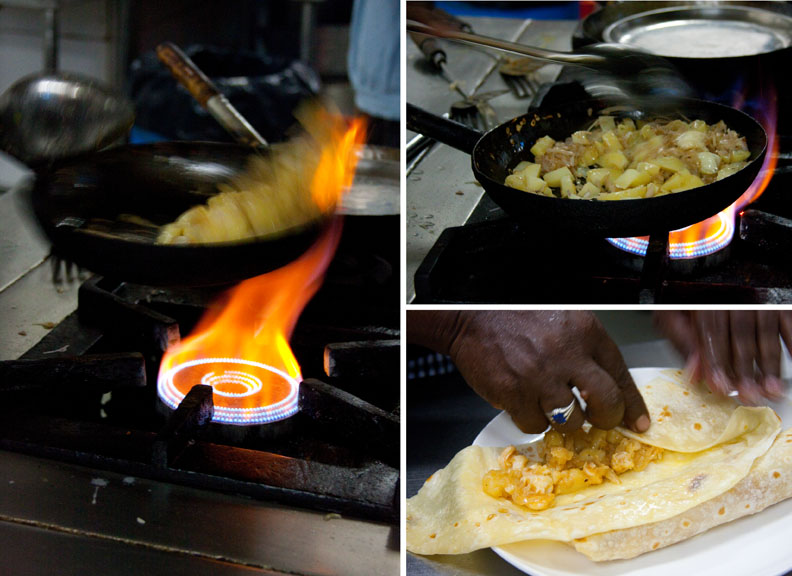
Heat the olive oil in a shallow frying pan and add the onions. Heat on medium flame till translucent and add the prawns. Toss around till cooked (ensure you do not overcook them, about two minutes) and add the potatoes, tomato sauce and salt. Mix well and spoon in the butter. Toss till well heated and the butter has melted.
To Serve:
Open up the roomali roti and spoon in 1/6th of the mixture on one corner of the roti. Roll up the roti like a wrap and serve it hot.
Variation:
You may use your leftover Rotis which are a day old, you may also use the ready made tortillas for these wraps.
Hold on till the next in the series… some more mains coming up…
Nikhil Merchant
Hospitality Writer | Culinary & Bar Consultant | Restaurateur | Brand Evangelist