
x
N
G
Of Ethnic Proportions
I love food trends. More so, I love studying them.
While my parallel career on writing allows me to be relatively in-tune with world food trends supported by the wide nexus of people I follow on my social media circles, it is finally dependent on practical ‘ground reality’ on what works and what does not?
These are purely my observations for trends on what is served up outside the comfort of your kitchen (or tempts you to cook in form of ingredients), what is in demand, what is it that tickles ones tastebuds and in today’s times do we really eat for our Stomach? Mind? Nutrition? or… for Fads!
I am beginning to believe that while we keep in mind to feed the stomach and treat nutrition as a necessary evil, it all boils down to a fad.
Now don’t get me wrong, it could be a good thing (after all we do need to survive in this industry, and people must eat what they demand, it is a give and take), but it has also set off a chain of inane trends which surprise me if not shock. Over the past decade it has been a clear cut case of fad driven drivel which gets manufactured in kitchens and all forms of creativity, taste, cooking culture and technicality is swept under the kitchen mat.
One of the most (ab)used cuisines are typically ethnic. This term is quite subjective as about a century ago, food which did not come from ‘homeground’ was termed as foreign or international (or continental in India). It is a term loosely used these days and supposedly dating back to 1950’s in USA. I further learnt spending my time here in the United States that “ethnic food” is food which is not made for / by the whites, but who undoubtedly savor it. With this comes some form of double standards too, I mean, why isn’t French, Japanese, Italian cuisine – ethnic?
There is a certain kind of expectation associated with ethnic cuisine. Typically foods which are Thai, Indian, Middle Eastern etc. are considered ethnic. These cuisines have permeated most western markets and have been slotted as being fast, casual, cheap. In most cases they are considered nothing more than just great food without the frills (service, experiences, authenticity, creativity can all take a hike, as no one knows better).
This perception has annoyed me over time, as I come from an ‘ethnic’ background too had I to pin my position in the eyes of the food world in the west.
Ethnic cuisines have been around in the west for a long time now. Starting with Asian influence of Chinese and Thai, who have mostly captured the markets (and hearts!) of the western civilization. The Middle East have found a niche but it is charting dark waters compared to the bigger fish. As for Indian, well they have made their presence felt but in a very sacred, quiet and inconspicuous way.
One of the common traits of these ethnic cuisines is that they have remained stagnant. A majority of them have not changed themselves around to incorporate anything traditionally or authentically justifiable in the cuisine. By this I mean there is a certain level of westernization of the food when it left its original shores (mostly taken away by travelers or colonizers, or brought in by immigrants). Over the years the palates have changed and people have travelled to see the world, but these ‘ethnic’ cuisines have found solace in cocooning themselves in what they started off with – Copy-Paste menus, similar flavor profiles, lack of traditional cooking styles, mediocre (read: packaged) ingredients and the same old run-of-the-mill “how spicy on a scale of 1-10 should i make your curry/sauce/meat/veggie”.
Indian food has taken centerstage in the past few years. Today you pick up any magazine or online publication worth its salt and you see a mention, an adaptation, a snippet or a whole story dedicated to our fine cuisine. This has also led to some serious innovations in the trends of food and eating habits amongst humans, not all in a good way.
I had mention the (ab)use of ethnic cuisines and it is followed by the adaptation of Indian ‘everything’ in anything remotely edible. It has gotten to a point of such irritation that I take it personally when I see the ludicrous association with our dishes. It is literally a bastardization of what was once such a unique, quality driven, culturally conscious cuisine.
In one fell swoop, the history, beauty, traditionalism and flavors have all been lost in the melee of innovative ethnic cuisine. From using turmeric as a wonder ingredient in lattes to cookies, to fake clarified butter being sold at obscene prices in the name of superfood ghee. From chicken tikka in bbq sauces to chips (I actually bought a chip packet last week with chicken tikka flavor, just to understand what is it that caught the fancy of the manufacturer, it was bland, red in color, with no fake chicken flavor even and had faint traces of soggy cumin muddled with a really sad version of chicken tikka masala mix) to the biggest evil of all – ‘fusion’ … the list goes on…
I am a traditionalist by heart. My love for cooking stems from research, study, experiment and reading up on some of the oldest stalwarts in the world of food. At home, being subjected to real food and culturally sound, cooking was as clean as clean can get and we ate good food which made me what I am today. As I started growing in my field I realized I liked cooking less and less of trend/fad driven food or fusion and was attracted to learn the ways of traditional cooking – be it Indian, French, Japanese or even American. My angst today stems from the short sightedness of the creators and the diners of today, if we don’t make a move to preserve our cooking culture, it is certainly going to be lost forever. Trust me it wont take more than a decade or two to let that happen.
Of the lesser known ethnic cuisines – food from Morocco, the full Arabic name al-Mamlakah al-Maghribiyyah translates to “Kingdom of the West” is a refreshing change from the current ‘west’ adaptations of ethnic foods. I have seen and tasted this cuisine around the world and it has remained pretty much untouched and original. More so because the people who probably run it in places apart from the country of origin, have no desire to fuse or convert it into a God-forsaken weird combination of flavors and styles (or am I thinking too soon!).
There was one particular dish I had tasted a long time ago. Holidaying in Goa and the chef at the restaurant I had visited had prepared this as the special for the day. He had been inspired, rather, kept the flavors intact of a moroccan chicken dish from a recent visit to Marrakech. I was blown away with its composition and the taste lingers till today. Ever since, I make this dish on and off and it has always been a hit.
I recently made this again and thought of recording the flavors (cooked in my unique style, after understanding the nuances of how its originally made) on the blog for eternity. It is natural for me to share the things I love and experiment with and this dish holds a special place in my heart, especially since my little tirade up there inspired me to remember the dish.
As usual I do not depend on packaged spices and canned ingredients and I would urge you to spend that little extra time and effort to stick to the recipe instead of making a run to pick up a ‘moroccan spice mix’ from the ethnic foods aisle in your neighborhood grocery store.
I have also included a side of Cous Cous which is a typically middle eastern staple and goes really well with this dish.
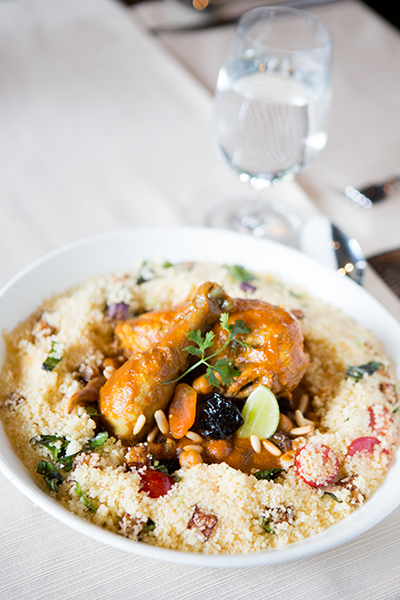
Moroccan Spice Glazed Chicken with Basil Cous Cous
Ingredients
- 1 Kg Chicken Legs
- 1/4 cup Olive Oil
- 2 tabsp Salted Butter
- 1/4 Cup Dried Apricots
- 1/4 Cup Black Raisins + Golden Raisins
- 1/4 Cup Dried Cranberries
- 1/4 Cup Almonds (Blanched and Skinned)
- 3 tabsp Pine Nuts
- 1 Red Onion thinly sliced
- 8 Sprigs Parsley
- 1.5 Cups Chicken Stock
- 2 tabsp Honey
- 1- 2” stick Cinnamon
- 1 Bay Leaf
- Few lime wedges
Moroccan Spice Marination
- 1 tsp Cumin Powder
- 1 tsp Salt
- 1 tsp Black Pepper Powder
- 1 tsp Cinnamon
- 2 tsp Dried Rose Petal
- 1/2 tsp Coriander Seed Powder
- 1/2 tsp Red Chili Powder
- 1/2 tsp All Spice
- Pinch of Clove Powder
- 3 tabsp Olive Oil
- 1/2” Ginger Grated
Basil Cous Cous
- 1 Cup Dry Cous Cous
- 8 Cloves Garlic (Flaked)
- 12 Basil Leaves (hand torn)
- 1 Tsp Salt
- 1 tabsp Olive Oil + A splash
- 2 Cups Vegetable or Chicken Stock
- 1 tsp Pepper
- 4-5 Fresh Red Cherries Halved (optional)
Method
For marination
- Prep the chicken legs by washing them throughly, towel dried and making small slits on the surface with a sharp knife. Set aside.
- In a large bowl, mix together the ingredients for the marinade starting with all the dry ones first and then adding in the wet. Whisk briefly.
- Add the prepped chicken legs and toss to coat. Saran wrap the bowl and refrigerate to chill for at least 2 hours.
For Basil Cous Cous
- In a saucepan, boil the chicken/vegetable stock with another 1/4 cup of water along with olive oil, pepper and salt.
- Heat a mini pan with a splash of olive oil and stir fry garlic till browned. Add this to the stock above.
- Pour dry Cous Cous along with half the torn basil leaves and give it a boil. Turn heat down to a medium and continue cooking the cous cous till they become larger in size (little pearls). Cover, shut off the flame and let it sit for 10 minutes.
- To final prep – toss lightly with a fork, add halved cherries and the rest of the basil and set aside to plate.
For the Cooking & Glaze
- In a deep set skillet add 1/4 cup olive oil, heat through till smoking.
- Add the sliced onions and cook till browned, stirring frequently. Remove them with a slotted spoon and set aside.
- Add the marinated chicken legs to the same oil along with the butter and cook on each side till light browned and cooked through.
- In another saucepan, quickly give the chicken stock, honey, cinnamon and bay leaf a boil on high heat. Continue cooking till you have a thickish glaze. Keep it warm.
- Return the browned onions to the chicken, add the dry fruits, nuts and any remaining marinade. Continue cooking for about 4-5 minutes till the juices have come together.
- Add the glaze after fishing out the cinnamon and bay leaf (You may leave these in, doesn’t matter). Heat till the glaze sticks to the chicken and gives it a nice shiny surface to the skin. Finish it off with some fresh parsley and get ready to plate it.
How to Serve:
Traditionally a terra-cotta Tagine is a great way to serve up this dish, if you don’t have one, a round /oval 3” lipped platter works great too. Place the Cous Cous on the edges of the Tagine / Platter, pushing it to the sides and making a well in the center. Place the glazed moroccan chicken legs in the center, garnish with more parsley and the lime wedges if desired and serve it with the lid on – opening it with a flourish before serving.
On another note, if you want to go seriously authentic. Cook the whole dish in a flameproof tagine. The key is in slow cooking (a really low flame) and over a charcoal fire. Just follow the recipe but cook it all as shown in the different steps in the same vessel. The chicken will have a mild smoky flavor if you use a charcoal flame.
There are many types of tagines, but they all work the same way. The conical lid allows steam to circulate during cooking, which then creates condensation that drips back onto the meat, fish or veggies, keeping food moist.

Ng Editor
Hospitality Writer | Culinary & Bar Consultant | Restaurateur | Brand Evangelist