
x
N
G

Humming a New Tune
I learnt a new food related phrase it’s called “Ethnic Cuisine”
In the United States there has been a revolution in the format of world cuisines and ethnic cuisine has taken centre stage. If I was to sum up what ethnic cuisine means, the answer lies in the breakdown of what the two words actually mean – it is basically food which comes from a group which share common cultural values, languages and maybe even religion. In the general sense it is such an obscure term that when I first heard it, it immediately make me think of lesser known regions of the world and their style of cooking. It turns out that in North America, this term is loosely interpreted as cuisines from lesser known regions of the world but pretty much sum up every country /region except America. Well, for starters Indian cuisine is deemed ‘ethnic’, so is Mediterranean, Thai, Chinese and so on and so forth even including cuisines from Uzbekistan, Ethiopia, Columbia… (What’s funny is that French cuisine is still called ‘French’!)
Since the past few years most of America has been focusing on ethnic cuisine in all forms. The realization that spices, powerful herbs, traditional cooking methods of the world, agricultural diversification (the link speaks of the growth in ethnic Mexican but the Country has seen its fair share of varietal ethnic cuisine meander its way into its food practices) and most of all travel has played an important part in the mushrooming of ethnic cuisine. On the flip-side, there have been big advances in plant breeding and animal breeding, such as crop hybridization, GMOs (genetically modified organisms) and artificial insemination of livestock. Further down the food chain, innovations in food processing and food distribution all which led to the population thirsting for foods from around the world (a clear cut eg. Edamame, most of what is available widely in USA is all GMO yet it is so sought after that people consume it unabashedly). There is a veritable mine of information about the negative effects of these newer advances and they have been vilified by a huge chunk of the population. These new processes stem from the fact that America is indeed consuming more types of foods than what they did many years ago apart from ‘more food’ in general.
Diners today are on the lookout for newer flavors and are incorporating it in their daily consumption habits. I remember a time (maybe two decades ago) when I had guests from other countries over in India and they would balk at the thought of having something even remotely spice laden. The unfamiliarity with our herbs and vegetables was shunned quite easily and Indian food had this presumptuous characteristic of making one rush to the loo within 10 minutes of consuming it (yes if you have three plates of sev puri during the monsoons from a local street food vendor, then you have pretty much set the precedent yourself).
Today, the very same diners crave ethnic cuisine like a drug. Well who wouldn’t, as it is indeed quite a palate change from the usual and enticingly complex. In fact, I recollect this little incident being out on a date in sunny California a couple moons ago. I love to try out new places and while it is a risky proposition to take someone out for the first time in an uncharted place (I once landed up in a cubby hole full of bikers even though the description was that of a stately lounge) it is an exciting way to discover new places with a significant other (also sets the tone for conversations and non-formalities). I usually find a boulevard or a neighborhood with streets full of restaurant and bars, this way you can take a little walk and step into a decent looking place for either a drink or some nosh or both. We walked into this little lounge which looked like a quintessential American place, run by an American with American bar eats and the usual classic cocktails on the menu. Fun! I was reading through the menu and came across several popular American bar eats but with a unique variation in each of them. There was the original Hot Chicken Wings but under it was a ‘bar special’ variation ‘Tandoori Chicken Wings’, another dish were BBQ Lamb Sliders and under it was the bar special ‘lamb kebob sliders with hummus’ the list went on…
I asked the bartender which of the chicken wings I should try. He looked at me and said while his personal favorite was the original preparation I could try the Tandoori one since it was quite popular. Totally intrigued I ordered both. It turned out decent but did not hold a candle to the original preparation. It had a reticently spiced marinade to what could have otherwise been a kick of a variation. I went on with my little analysis of this inclusion with the bartender (Bob, who incidentally had a best friend named Nikhil) about why there was a hint of ethnic inspirations in the menu. His place was a local favorite no doubt, but it was similar to your neighborhood bar where one could pop in for a quick beer and a snack, so why?
Turns out (and this was what I experienced in several dining spaces over my time there) that ethnic cuisine was in demand and flavors of the far east along with the middle east were infact the flavor of the season. This was an exciting discovery; America was truly humming a new tune in its food space.
One increasingly popular form of ethnic cuisine I was exposed to (and a fan of) was Lebanese cooking. L.A.’s numerous Levantine restaurants would serve up mezze platters with raw or pickled vegetables, hummus, baba ghanouj and bread or entire meals consisting of grilled marinated seafood, skewered meats and a variety of cooked and raw salads. Hummus formed a part of my daily diet (I always had one tin in the fridge) especially since chickpeas are full of protein and that was something I was on a constant lookout for. Hummus is also very versatile; I would eat it as a snack with cucumber and carrot sticks or with cocktails as a dip with pita chips. It would also be a part of every Mediterranean meal I would cook up once in a while (a base for chicken breast or stuffed inside bread with BBQ’d pork. I was lucky enough to find places which served up all kinds of ethnic cuisines including some in my neighborhood.
Eggs would also form a part of my daily intake (usually for breakfast) but I was always looking at ways to incorporate them in my other meals. When I came back to India, I missed my meat / seafood induced meals as well as the ingredients which helped me put together fun cuisines, especially the ethnic ones which I was so fond of. I realized I had to find ways to incorporate some of my favorites into my old Indian diet, that too an egg-etarian one (we eat vegetables and eggs at home; it is a meat and seafood free kitchen in India for me).
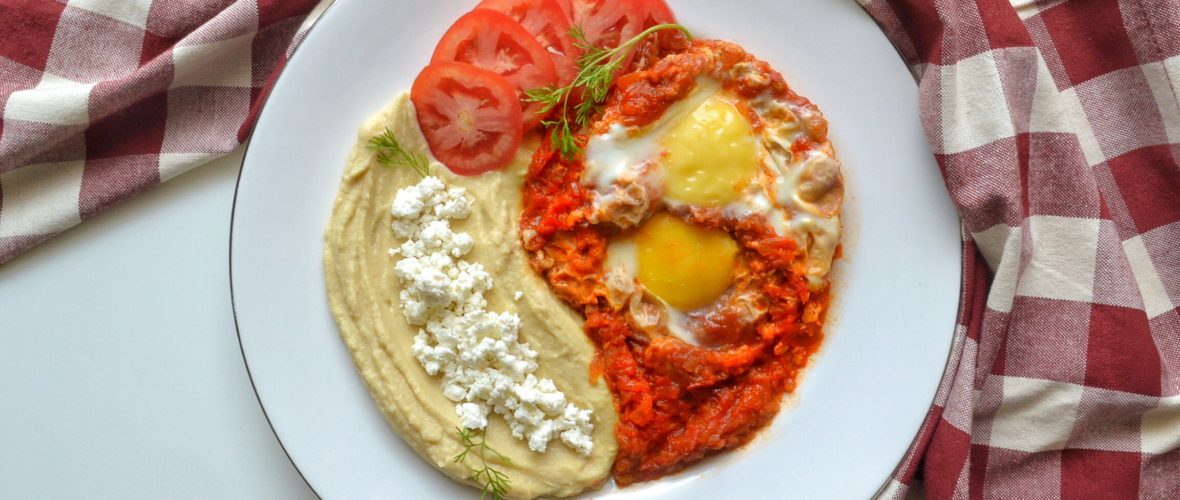
I found the best way to sate myself was to combine all these little favorite inspirations (hummus, eggs, etc…) and put together a one dish meal which would satisfy my cravings all in one go. It comes in the form of this Moroccan | Turkish dish called Shakshouka.
Shakshouka is basically eggs poached in a simple spiced tomato based sauce. I upped the game by adding my favorite homemade hummus, some fresh tomatoes which add that umami punch and Goats Cheese to complete the dish with a creamy savouriness. This combination is delightful as a one dish meal since it has all the elements of a well balanced palate experience. It is also very easy to put together and with a salad and some chicken Mediterranean kebabs makes for a complete dinner party menu.
Traditionally a Shakshouka is prepared in a cast iron pan or a tagine but a frying pan works best (especially since this is a plated variation). If you want to go more traditional at a dinner part cook it in the traditional vessels such as a cast iron pan or a tagine and serve it with the other elements on the side. It makes for quite a dramatic appealing dish.
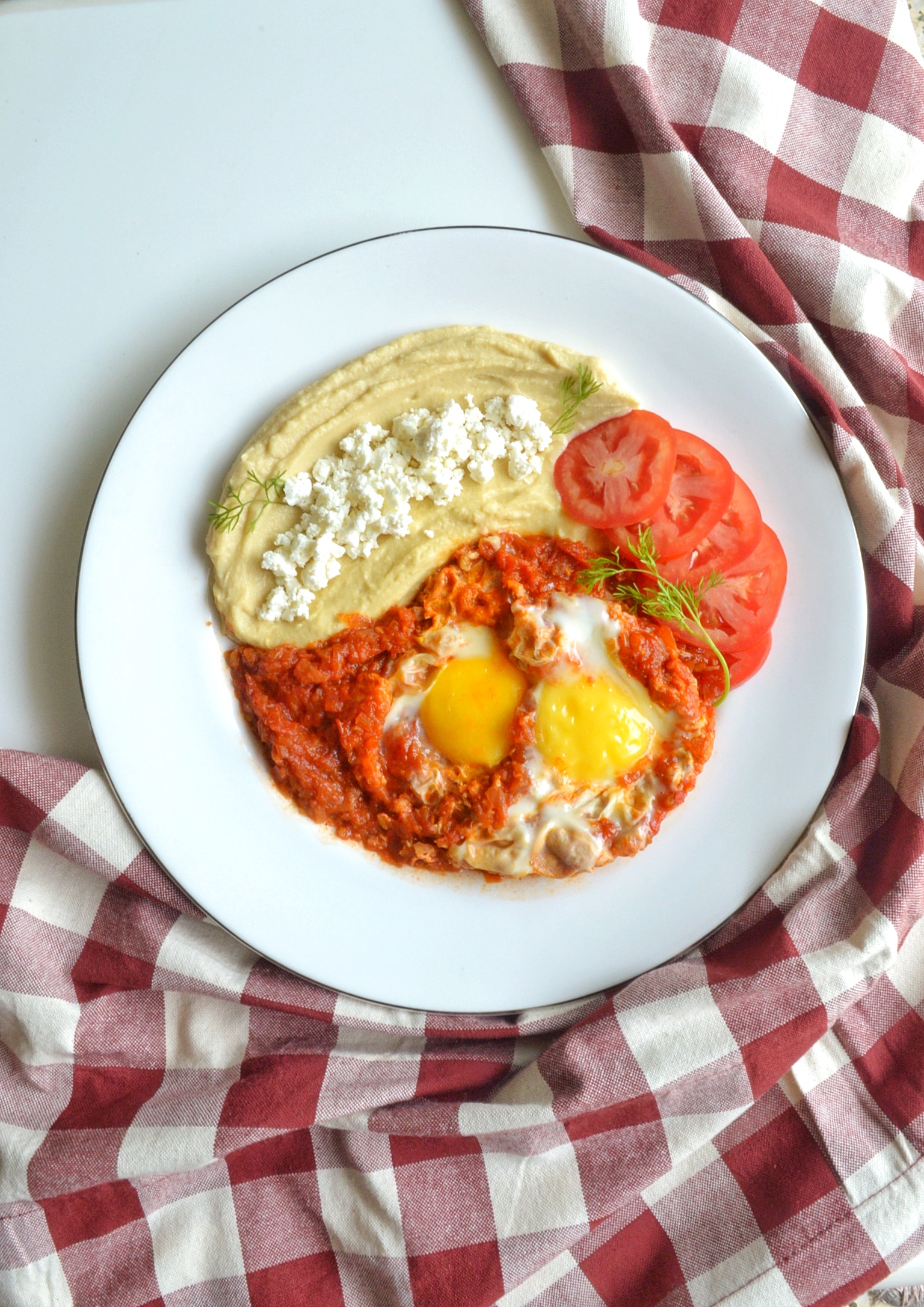
Shakshouka with Hummus & Goats Cheese
Ingredients
For the Shakshouka
- ½ Kg Tomatoes (chopped fine)
- 1 small Onion (chopped fine)
- 6 tablsp Tomato Puree Concentrate
- 6 cloves Garlic (minced)
- 1 Dried Red Chilli
- 1 tsp Roasted Cumin Powder
- 2 tsp Smoked Paprika / Regular Paprika
- 2 Tablsp Olive Oil
- ½ cup Water
- Salt & Pepper to taste
- A Squeeze of Lemon Juice
- 8 Eggs
For the Hummus
- 1 cup Chickpeas (soaked overnight & cooked till soft the next day)
- 2 tsp Roasted Cumin Powder
- 1 tsp Red Chilli Powder
- 3 cloves Garlic
- ¼ cup Olive Oil + 1 tablsp
- ½ Lemon Squeezed
- Salt to taste
To serve
Crumbled Goats Cheese
Fresh Tomato Slices
Cilantro / Parsley / Corriander Leaves
Meathod
- Heat the olive oil in a frying pan with a lid. Throw in the garlic and onions and stir till lightly browned and fragrant.
- Tear up the red chilli and add it in along with the cumin and paprika. Add the tomato puree and the tomatoes. Add rest of the ingredients and cover and cook till the tomatoes have gone soft.
- Open the lid and mash the tomatoes up with the back of the spoon. You should have a chunky saucy base.
- Crack eggs one at a time atop this sauce, make sure the yolk is intact.
- Cover and cook for about 3-4 minutes or till the whites have set.
- Your Shakshouka is ready to be served.
To prepare the Hummus
- Heat the 1 tablsp of olive oil in a small heavy bottomed vessel and brown the garlic cloves in it.
- Blend all the ingredients in a blender along with the browned garlic, till well combined. You should have a pasty hummus. If you feel it is too thick add some of the soaking liquid or maybe a little more olive oil as you desire.
- Pour out into a bowl or plate and sprinkle a little olive oil atop. You may sprinkle some red chilli powder for a little spice kick. This is to ensure the hummus does not dry out.
- Leave aside in a cool place for the flavors to come together.
To serve – Spoon out the hummus into a plate, arrange tomato slices beside it. Spoon out 2 eggs per plate along with the poaching tomato liquid, sprinkle goats cheese and the herbs. Serve it up immediately as a delicious one plate meal.
You could add a side of fresh pita bread or a couple of slices of good chewy bread to mop up your meal with.

Ng Editor
Hospitality Writer | Culinary & Bar Consultant | Restaurateur | Brand Evangelist