
x
N
G
Churned & Revived
I was always a fusspot when it came to food, even as a kid. Being the first born and mother having extra pangs of mollycoddling she would give in to my demands and our tables were always groaning with home cooked delights found in a typical Gujarati household. On the positive side, I would love to eat anything and everything which was put in front of me, I had no reservations as far as food was concerned be it greens or pulses or soups or breads. Though being brought up in a typical Indian joint family with a large number of relatives to match, we were (and still are) extremely proud of our traditional Indian cuisine. Infact, during my adolescence the only varied cuisine which would be available outside was Chinese and Indian with a couple of Pizza chains thrown in for good measure (fast foods, Thai, Italian, etc. were unheard of during those days or were left to the meat eaters and travellers abroad).
A typical Indian household experimented in the kitchen at a different level than what our generation is used to today. The ladies of our home would chatter over the new Tarla Dalal “Continental Cuisine” cookbook and dishes such as Vegetable Au-Gratin and Cream of Tomato Soup and Salad with simple lemon, pepper, salt dressing would be the special dish of the week when something different was needed.
Times have changed, now I cannot do without a meal outside nor can I stop myself from hoarding ingredients to make the dishes I have tasted in my food adventures out of home. Everyday is a different experience, being a part of the Food Blogging world and to top it off following my passion for cooking; I am constantly in the urge of mixing and matching flavors and creating different dishes. The atmosphere in the home kitchen is always floating with different smells and flavors. We barely cook regular Indian home cooked meals as am constantly creating new experiments in the kitchen, after all a family can eat two, three of four meals at the maximum in a day.
Just like how certain things or ideas don’t go out of fashion, A typical Indian sit down meal, popularly called ‘Thali’ in our local language, meaning (Plate) is here to stay no matter what. In the early days the day would start with the food being cooked and served up in a silver Thali and thereafter offered to the holy deity at home, the offering would then be divided according to the members of the household and served in the individuals Thali with more portions of the cooked dishes.
Eating from a Thali is an event by itself. Typically the condiments such as sweet chutney, pickles and spicy chutneys from chili to garlic flavors are spooned out, this is followed by the salad and/or raita (sweet and savory hung curd mixed with various fruits or vegetables) and roasted papad. The individual bowls would then be filled with various vegetable preparations which could be sweet, dry, wet and spicy depending on the cuisine of the day. Pulses such as dals, sprouts, chana and various other broth or gravy like preparations would be served in the numerous bowls laid out in Thali (funnily enough, there are always enough individual bowls to hold all the preparations for that day). The farsaan or Indian savory snacks / appetizers would come next – always one fried and one steamed, closely followed by Indian breads of different kinds, ranging from sweet breads such as puran polis to regular flour bread roasted over an open fire and puffed up like tiny whoopee cushions called Rotis. Flours such as Millet, Barley and Sorghum are sometimes used to make different flavored breads. The sweets always come last. Though I beg to differ on that level, I still like my sweet morsel to be served up with the mains.
I recently visited the revamped Indian Thali restaurant in Crawford Market, Mumbai called ‘Revival’. I was greeted by their cute little mascot, who is proudly called Bhoji. The restaurant was originally called ‘Rajdhani’ (and since their initiation in 1947, they were called Ishwar Bhuvan) and known amongst the South Mumbai dwellers and food lovers as the Rajdhani. It has not only revamped from being a Gujarati / Rajasthani cuisine specific outlet but also renamed itself to Revival. It now has a host of dishes spanning nearly every single cuisine Pan-India. I went there with a couple of my foodie friends Harini, Jyotika, Pranav, Vinda and Nikita, since we always meet at fancy fine-dine differential cuisine restaurants, this time I thought why not go back to the root for our Indian cuisine. The best part about the visit was the fact that we got to spend time in their kitchen and watch the Maharaj’s go at it with the preparation of our meal. Infact this could possibly be the only restaurant in Mumbai which has a sign on its kitchen door “welcoming” the guests.
Indian cuisine not only in India, but also abroad restricts itself to Mughlai, Punjabi and Tandoori, but a Thali being 100% vegetarian is one meal which is sometimes left behind. People looking for a Indian meal which tantalizes each and every part of your tongue, should definitely have a one on one with the Indian Thali. The owners Mr. Kamlesh Barot and his incredibly talented and charming wife Mrs. Vandana Barot made it a point to keep us enlightened as we wolfed down course after course.
Revival boasts of about 900 dishes a month in quick rotation. Mrs. Barot handpicks and experiments with all the dishes before its put on Revival kitchen tables and for approval by their executive chef. Their Maharaj’s (or cooks) are well equipped and trained to recreate the dishes as shown to them and the team ensures that when the final Thali arrives on the table, every single dish is matched to perfection. Keeping in mind all the taste senses – bitter, sweet, salty, spicy and umami, each and every dish ensures that your tongue does not miss the sensations it’s expecting. The restaurant has themes every month depending on the seasons and festivities surrounding our Indian culture.
The time we went for our dinner, they had the coastal cuisine season going on that month, where dishes from all the coastal regions of India right from the Saraswat, Goa, Tamil Nadu, Karnataka, Andhra, Orrisa, West Bengal, South (Kerela) to the West (Gujarat) were served up. The menu was Sindhi, Parsi, Marathi and Bihari the month before. Every table had small LCD televisions explaining the 44 items on the menu that day and how they were to be savored in sequence (A thoughtful technological addition to guide the guests, especially expats to understand the way of eating an Indian meal). We were made to feel a lot more special by Mrs. Barot completely changing the menu just for our dinner. Though we would have enjoyed the Coastal Cuisine, we were in for a surprise as she had put together a mix of Gujarati, Marwadi and Rajasthani cuisine – a rich combination which would ideally be fit for kings of those regions served to us in golden ‘Kansa’ (bell metal) crockery.
Coincidentally, Mrs. Barot told us the reason for the change in menu, especially for us was because she had served this menu on the sets of the film Jodha Akbar, (A scene where Jodha serves food to her Akbar) albeit fitting the bill for a meal fit for a King.
The meal starts with their signature mute, sign-language service. The restaurant even employs the hearing disabled. The waiters keenly sanitize our hands in traditional warm sandalwood scented water poured out of brass spouted vessels, invigorating your senses and palates. The welcome drink this time flavored with holy basil (they have a variety depending on seasons, ranging from rose to ginger to ‘mulethi’ or licorice is sipped to cleanse and accentuate your tongue and gastric juices. The meal that created a wow for each one of us, was the ayurvedic and organic influence as it was prepared in transfat free oils and ghee’s. The grande finale at the end was a selection of desserts which you get to taste (just like a dessert trolley but Indian flavors) and pick, including the sugar free and vegan ones. We of course picked all of them and shared a bite each. The unlimited meal ended with Paan Tabak (A cheerful wood box holding our Indian delight – Paan and various post-meal seeds to chew on) and a unique bowl in which the bill is brought, the Kansa bowl when struck, chants the ‘Ohm’ sound. A surprise element while we chewed on our Paans was their unique Zodiac birthday cards which show the ‘food personality’ according to a persons zodiac signs.
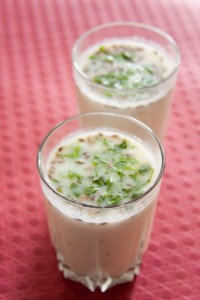
My personal excitement was the crème of their dish, the smoked buttermilk. A delightfully light curd based drink, popular in Indian households. It’s made out of whisked curds and chilled water, sometimes just salted but in this case smoked. Mrs. Barot has been given the recipe by her father-in-law and the recipe remains the same through generations. Personally not a curd / yoghurt lover this piqued by interest as this drink was smoked. Typically, a large trolley of sorts with a tunneled pit on the top made of brass is filled with burning hot coals; a dollop of clarified butter (ghee) is dropped in with tiny pieces of garlic and fragrant spices. When the ghee hits the coal it starts smoking and a pewter or brass glass is overturned quickly on the pit. The smoke is allowed to infiltrate the hollow of the glass and in one quick motion the glass is upturned (still smoking) and whisked, churned; freshly sweetened buttermilk is poured into it. The buttermilk is churned back and forth with another metal glass thereby allowing the smoky mix to be absorbed into the drink and a spoonful of spices and salt is sprinkled in for that extra spice; A definite road trip to smoky heaven.
I recreate this smoked buttermilk quite often at home now, I leave you with a simple recipe for you to experiment with. Drink up during hot and humid weather, the upcoming October heat shall be beat by this sweet elixir.
Smoked Buttermilk (Chaas)
Ingredients
- 1 cup – Thick Curds
- ¾ cup – Chilled Water
- ½ tsp Ghee / Clarified Butter
- 1 clove Garlic
- 1 tiny piece Ginger
- 1 tiny piece Green Chili
- ½ tsp Cumin Powder
- ½ tsp Coriander Powder
- a pinch of Pepper Powder
- a pinch of Asafetida (Hing)
- Coriander leaves to garnish
- Salt to taste
- A few pieces of coal
On an open fire heat the charcoal pieces till red hot.
Take the curds and water and churn well with a hand mixer or a manual churning machine till milky and frothy. Transfer into a glass of your choice.
Place the heated charcoal piece in a deep thick bottomed and large vessel and grate half the ginger and garlic onto it, quickly spoon the ghee onto the charcoal piece with a pinch of cumin. The charcoal piece shall start smoking. Immediately cover the piece with a brass or pewter glass of same size as the one in which the buttermilk is poured in. After half a minute or so, remove the glass from the charcoal piece. You will see that the smoke is gradually escaping once the glass is upturned, quickly pour the buttermilk from the other glass and pour back and forth a couple of times. Add rest of the ingredients (half for one glass, reserve balance for the other serving) and toss between two glasses once or twice. Serve up immediately. Repeat for the other half.
You have two yummy glasses of smoked buttermilk (chaas) to savor.
Hop on over to Revival at 361, Sheikh Memon Street, near Crawford Market & Jumma Masjid, Mumbai for your Thali Fix

Ng Editor
Hospitality Writer | Culinary & Bar Consultant | Restaurateur | Brand Evangelist